
Embarking on a spiritual awakening can feel like being handed a compass that spins wildly, pointing you toward a destination you never knew existed. You're navigating a vast, uncharted inner world without a map. This is where a spiritual awakening support group comes in—it’s not just a meeting, it’s a sanctuary. It's a place to land, to share the incredible and sometimes confusing experiences you're having, and connect with others who truly get it.
You Are Not Alone on Your Spiritual Path
Are you experiencing profound shifts in how you see the world? Questioning everything you thought you knew? Maybe you feel a sudden, deep connection to the universe or notice your intuition is becoming startlingly accurate. These moments are filled with wonder, but they can also feel incredibly isolating. It’s hard to explain these deep, personal shifts to friends and family who aren't on a similar path.
Think of this guide as your invitation to find your base camp. A spiritual awakening support group is that safe space where your journey isn't just understood—it's celebrated. In a community like this, you quickly realise that the strange, beautiful, and sometimes bewildering moments of your awakening are shared by so many others. That shared understanding is more than just a comfort; it’s the very thing that helps you ground and integrate these powerful new ways of being.
Why Community Is So Crucial for Spiritual Growth
The deep longing for community during an awakening isn't just a fleeting feeling; it’s a natural and healthy response to profound inner change. Trying to go it alone can feel overwhelming, but a supportive group provides the encouragement and stability you need to keep exploring your own truth with confidence.
A spiritual awakening support group offers a few beautiful gifts:
- Validation: When you hear someone else describe an experience that mirrors your own, it’s a powerful confirmation. It reminds you that you aren’t making this up—your journey is real and deeply significant.
- Shared Wisdom: Everyone brings their own unique perspective. Members offer insights, resources, and stories that can help you navigate challenges and open up to new stages of your own growth.
- Emotional Safety: It’s a non-judgmental container. Here, you can be vulnerable, express your deepest doubts, and celebrate your breakthroughs without any fear of being misunderstood or ridiculed.
This collective energy helps to normalize what can feel like an extraordinary and sometimes unsettling process. It makes it so much easier to weave your spiritual insights into the fabric of your everyday life.
The Collective Shift Toward Spiritual Community
The growing need for these groups is part of a much bigger story. We're seeing a cultural shift away from rigid, traditional structures and toward something more personal and authentic. For example, research on residents in Marin County, California, revealed that 53% of the population identifies as 'spiritual but not religious.' This speaks volumes about the growing movement toward experience-based spirituality that truly thrives in community, not just in old institutions.
This changing landscape shows that more and more people are searching for genuine connections and support systems that honour their unique path. Finding your tribe is a pivotal step in embracing who you are becoming and realising you're part of a much larger, collective awakening. Building a strong foundation within a spiritual community can profoundly enrich your entire journey.
Knowing When It’s Time to Find Your Community
So, when is the right moment to look for a spiritual awakening support group? It’s rarely a loud announcement. More often, it's a quiet nudge from deep within you—a persistent feeling that even with all this incredible inner growth, something essential is missing. It’s that subtle ache for connection that appears when you realize you can't, and maybe shouldn't, walk this path entirely alone.
Learning to hear these whispers is the first step. Think of them not as signs of weakness, but as invitations to go deeper into your journey by sharing it with people who genuinely speak the language of the soul.
The Feeling of Being Misunderstood
One of the first and most common signs is a slow, creeping sense of disconnection from your friends and family. You might be bursting to share a mind-blowing insight from your morning meditation or a wild synchronicity that left you speechless, only to get a blank stare or a polite, slightly concerned smile in return. Your loved ones mean well, of course, but they just don't have the context for the profound shifts happening inside you.
This can feel incredibly lonely. It’s like discovering a vibrant, beautiful new world and having no one to share the wonder with. That deep yearning to be truly seen, heard, and understood is a powerful signal that it’s time to find your people.
"Every addict feels that way in one way or another—that they have to fix what's wrong with them…threats that you might die, that you're going to ruin your life are completely meaningless." While from a different world, this sentiment really gets to the heart of it: we all crave understanding, not judgment. That’s the foundation of any real support system.
Navigating the Emotional Highs and Lows
Let’s be honest: a spiritual awakening is anything but a straight line to perpetual bliss. It's a full-on emotional rollercoaster. One day you’re feeling an incredible sense of oneness with the universe, and the next you’re deep in the trenches of shadow work, facing old pains you thought were long buried. It's all a necessary part of the journey, but trying to ride those waves alone can be completely exhausting.
A spiritual awakening support group acts as an anchor in these stormy seas. When you're flying high, they’re right there to celebrate with you. And when you’re down in the dark, they simply hold space for your struggle, reminding you that this too shall pass, without trying to "fix" it. Having people who can witness your entire, messy, beautiful experience without flinching is absolutely priceless.
When Your Intuition Overflows
As your spiritual awareness expands, you might feel like your intuitive tap has been turned on full blast. Suddenly, you're flooded with gut feelings, vivid dreams, and insights that seem to come out of nowhere. It’s powerful stuff, but it can also be confusing and overwhelming to sort through on your own. You might find yourself asking, "Did I just make that up?" or "What on earth am I supposed to do with this?"
This is where a group becomes your sounding board. Sharing what you’re experiencing allows others to offer different perspectives that can bring clarity. Hearing their stories also helps to validate your own experiences, building your trust in that inner guidance system. If you're curious about what this all means, exploring the four stages of spiritual development can give you a map for your journey. Recognizing that you need a community to help you integrate these new gifts isn't a weakness—it's a sign of real strength and self-awareness.
Exploring Different Kinds of Spiritual Support Groups
When you feel that deep pull to find your people, you'll quickly realise that spiritual support comes in many beautiful forms. A spiritual awakening support group isn’t a one-size-fits-all kind of thing; it’s a vibrant world of communities, each with its own unique feel and way of connecting. Getting to know the different options is your first step toward finding a space that truly feels like home.
What works for you will come down to your personality, your lifestyle, and what your soul is truly craving on this part of your path. Some of us come alive with the energy of a face-to-face gathering, while others need the freedom and ease of a virtual circle.
This image really captures the core human needs that often guide us toward finding a spiritual community as we awaken.
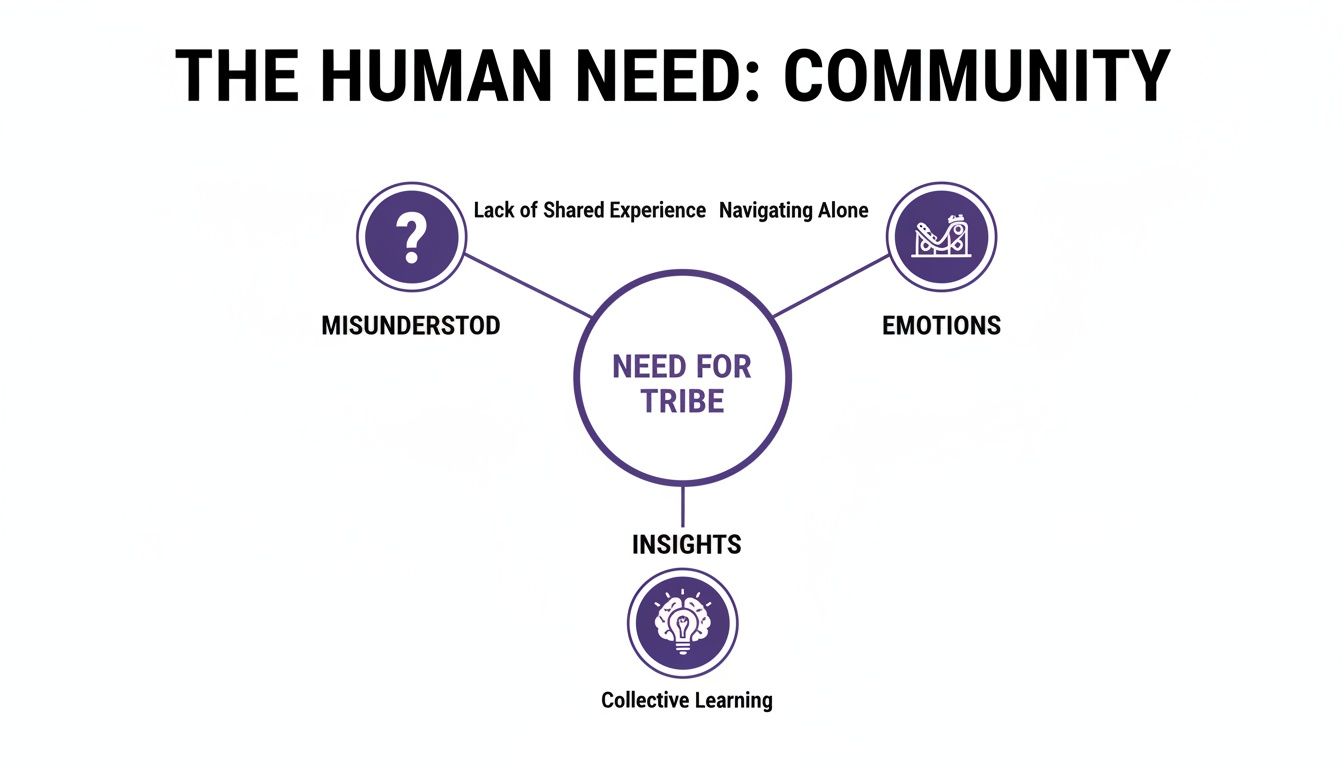
As you can see, feeling misunderstood, dealing with powerful new emotions, and making sense of profound insights are all huge reasons why we start searching for our tribe.
Online vs. In-Person Circles
The first big choice you’ll probably make is whether to look for a group online or one that meets in person. Online communities have absolutely flourished, becoming a lifeline for people in remote areas or those juggling busy schedules. They offer a way to connect with a global network of kindred spirits, proving that deep, meaningful bonds can absolutely be formed across distances.
Then there are in-person groups, which offer something irreplaceable: the shared energy of a physical space. There’s a special kind of magic that happens when you sit in a circle, look someone in the eye, and feel the collective presence of others who just get it. This setup is perfect if you’re someone who thrives on direct human interaction and wants to build connections in your local community.
Peer-Led vs. Facilitated Groups
Another important difference lies in how the group is led. A peer-led group is a gathering of equals, plain and simple. In this more democratic style, everyone shares the responsibility for holding the space, and the group’s own collective wisdom guides the conversation. These circles are often built on a foundation of deep trust and mutual respect, which creates a powerful sense of shared ownership.
A facilitated group, on the other hand, is guided by a seasoned leader, mentor, or teacher. This person brings structure, introduces specific topics or practices, and uses their experience to steer the group’s journey. This can be incredibly helpful if you’re looking for deeper teachings or a more organized environment for your growth. Having a skilled facilitator ensures the space stays safe, focused, and supportive for everyone, like in an online mediumship development group that offers this type of guided experience.
To help you sort through these options, here is a quick comparison of the most common support group formats. Think about what you need right now to decide which one might be the best fit for your life and your journey.
Choosing Your Spiritual Awakening Support Group Format
A comparison of the most common support group formats to help you decide which one best suits your needs and lifestyle.
| Format Type | Best For… | Potential Pros | Potential Cons |
|---|---|---|---|
| Online | Those with busy schedules, living in remote areas, or seeking a global community. | Accessibility, wide variety of groups, anonymity can encourage vulnerability. | Lack of physical connection, potential for technical issues, "Zoom fatigue." |
| In-Person | Individuals who thrive on physical presence, shared energy, and local connections. | Deep energetic connection, strong community bonds, no screen time. | Geographic limitations, scheduling can be rigid, may be hard to find locally. |
| Peer-Led | People who value equality, shared responsibility, and a co-created experience. | Fosters empowerment and autonomy, highly flexible, often free or low-cost. | Can lack structure, may be less effective without experienced members. |
| Facilitated | Seekers wanting structured guidance, specific teachings, and a professionally held space. | Expert guidance, safe container for deep work, clear focus and direction. | May have a cost, depends heavily on the facilitator's skill and integrity. |
Ultimately, there's no right or wrong answer here—only what feels right for you. Each format offers a unique pathway to connection and understanding.
Choosing a group is an act of self-love. It's about honouring your needs and finding a container that feels both safe enough to be vulnerable and expansive enough to grow. Trust your intuition to guide you to the right circle.
When your personal beliefs align with the group's structure, the experience often becomes much richer. Research has shown a powerful link between a person's beliefs and their commitment to a support group. For example, in traditional 12-Step programs, those with higher religiosity showed a 2.94-point increase in participation, while members of secular groups saw a smaller 0.91-point increase.
This tells us that finding a group whose spiritual (or non-spiritual) framework resonates with your own can make a huge difference in how much you get out of it. No matter which format you choose, the goal is always the same: to find a sanctuary where you can show up as your most authentic self and be met with understanding.
Here’s the rewritten section, designed to sound completely human-written and natural.
How to Find a Spiritual Group That’s Right for You
Finding your spiritual tribe is less about a methodical search and more about an intuitive journey. It's about listening to that quiet inner voice while you explore your options. The goal isn't just to find any group; it's to find a space that genuinely resonates with where you are on your path, a place that feels like coming home.
So, where do you begin? Your search can start right from your couch. Online communities and social media are buzzing with spiritual seekers. Try searching for phrases like “spiritual awakening circle,” “meditation group,” or “conscious community,” and add your city or neighbourhood to find what’s happening nearby.
But don’t forget to look up from your screen! The real world is full of hidden gems. Check the bulletin boards at local wellness centres, yoga studios, or those charming little metaphysical shops. Often, the most authentic connections are found through word-of-mouth in your own community.
Feeling Out the Vibe: Vetting Groups and Leaders
Once you have a shortlist, it’s time to tune in and do a little homework. This is where you get to be discerning. A group is only as healthy as its foundation, and if there’s a facilitator, their energy and approach will shape the entire experience.
Before you jump in, it’s perfectly okay—and smart—to ask a few questions. Think of it as a quiet interview to see if you click.
- What’s your approach to holding space for the group? This gives you a feel for whether they’re a formal teacher or more of a guide who lets the group’s wisdom emerge.
- How do you ensure this is a safe space for everyone to share? A group that values safety will have clear agreements around confidentiality and respectful listening.
- Is the group rooted in a specific spiritual tradition? This helps you know if you're walking into a space with a defined structure (like Buddhism or a specific yoga lineage) or something more eclectic and open.
- What are the costs or expectations for contribution? Healthy groups are upfront and transparent about any fees. There should be no mystery or pressure around money.
At the end of the day, trust your gut. Your intuition is your most powerful compass. If something feels off during a conversation or a first visit—even if you can’t put your finger on why—honour that feeling. The right group will feel right.
Navigating with Care: Red Flags to Watch For
Most spiritual communities are born from a beautiful intention to connect and grow. But as with any human gathering, unhealthy dynamics can creep in. An authentic group should lift you up and empower you to trust yourself more, never less.
Keep your eyes open for a few key warning signs:
- Putting the Leader on a Pedestal: A true guide will always point you back to your own inner wisdom. Be cautious of any dynamic where the leader is treated as infallible or questioning them is frowned upon.
- Pressure Around Money: It’s normal for groups to have fees to cover costs or compensate a facilitator. But if you encounter high-pressure sales pitches or promises of "guaranteed" enlightenment for a hefty price tag, walk away.
- Rigid, Unquestionable Beliefs: Spirituality is about opening up, not shutting down. A safe space welcomes curiosity, doubt, and diverse perspectives. It doesn’t hand you a rulebook and demand blind obedience.
- Us vs. Them Mentality: A supportive community should help you weave your spiritual insights back into your daily life. If a group encourages you to disconnect from friends, family, or the "outside world," it’s a major red flag.
The search for community is a global one, but some places have a particularly rich history. California, for example, has long been a beacon for spiritual seekers, home to legendary centres like Esalen and Spirit Rock. In Los Angeles, organizations like the Spirit Awakening Foundation have been doing this work since 1995 and even earned a 2023 Candid Platinum Seal of Transparency. This kind of longevity and recognition shows a level of maturity and credibility you can look for as a standard. If you're curious, you can learn more about California's leading wellness retreats to see what a well-established offering looks like.
Getting the Most from Your Group Experience
Finding your spiritual awakening support group is a beautiful first step. But the real magic? That begins when you actually step into the circle and participate with your whole heart. This is where insights from others spark your own personal growth. It's about so much more than just showing up—it's about learning the delicate art of holding space, listening with intention, and sharing with courage.
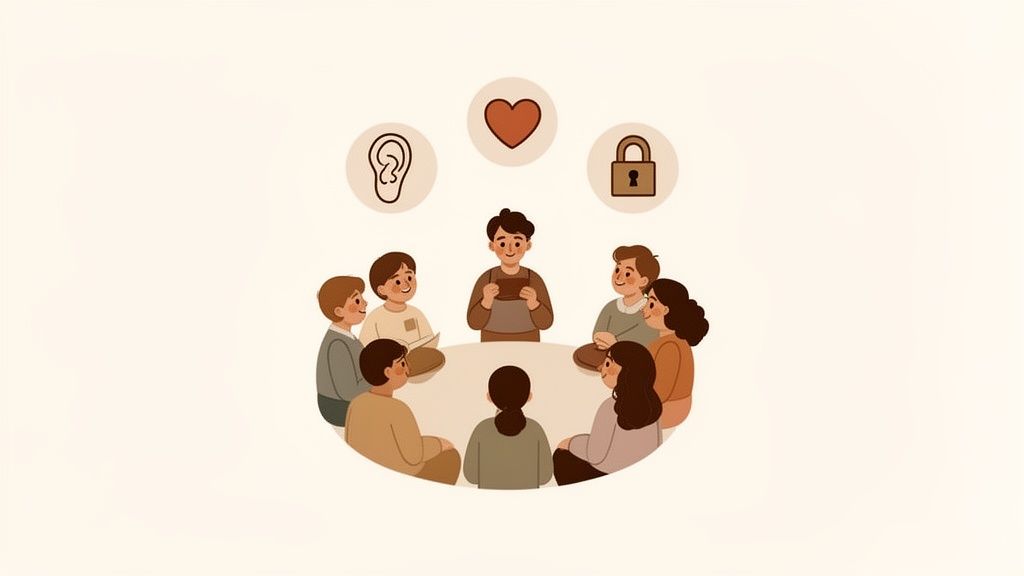
To become a cherished part of your new spiritual community, you’ll want to understand the unspoken rules of a sacred space. These aren't rigid laws, but gentle guidelines that protect the group, ensuring it remains a sanctuary of trust where everyone feels safe enough to be vulnerable.
Honouring the Sacred Space
Imagine your group as a container, holding the collective energy of healing and discovery for everyone inside. To keep that container strong and safe, every single person has a role to play. It's a shared responsibility, really, built on a few core principles.
Here are the cornerstones that make a group truly special:
- Practice Non-Judgmental Listening: Your job isn't to fix anyone or jump in with solutions. It's simply to listen from the heart. Offer your full, compassionate presence as someone else shares their truth. That's the real gift.
- Respect Absolute Confidentiality: This is non-negotiable. What is shared in the circle, stays in the circle. This unwavering trust is the bedrock of a safe group, allowing people to open up without ever fearing their stories will leave the room.
- Share from Personal Experience: Always speak your own truth by using "I" statements. Instead of giving advice nobody asked for, you could share a personal story that echoes what you're hearing. This builds connection, not a hierarchy of who knows best.
Following these practices is what turns a simple meeting into a powerful, co-created experience. In this kind of environment, where every journey is honoured, profound shifts can and do happen—for you, and for the group as a whole.
"A spiritual support group is a powerful catalyst, but your personal growth will flourish when you combine shared wisdom with your own dedicated reflection and practice."
Integrating Group Wisdom with Inner Work
The communal energy of your group is incredibly nourishing, but it’s only one half of the equation. The other half is the quiet, essential inner work you do on your own time. True, lasting change happens when you take the insights and "aha" moments from your group and explore them through your personal practice.
After a meeting, carve out some quiet time to reflect. Journal about what came up for you. Meditate on the feelings that were stirred. You'll start to notice how the shared experiences of others illuminate parts of your own path that were once in shadow.
This balance is key. Your group acts as a mirror, reflecting your own journey back to you and reminding you, again and again, that you are not alone. Your personal reflection is where you sit with that image, allowing its wisdom to truly sink in and become part of who you are.
It’s a beautiful, continuous cycle of growth. You bring your personal insights to the group, and you take the group's collective energy back into your life, creating a powerful momentum for your spiritual evolution.
Deepen Your Journey with Personal Intuitive Guidance
Being part of a spiritual awakening support group is like seeing your journey from a beautiful, wide-angle lens. It’s incredibly validating to realise you aren’t alone and that your experiences are part of a much larger, collective shift. That shared perspective is not just comforting; it’s essential for growth.
But for a truly holistic journey, you also need the close-up view. The one that’s focused entirely on your unique soul path. While a group gives you the strength of community, personalized guidance offers the clarity of individual focus. This is where intuitive readings and group work become a powerful, complementary pairing.
How Group and Personal Guidance Work Together
Imagine your support group as a vibrant, collaborative classroom. You’re learning from everyone’s stories, sharing wisdom, and growing together. An intuitive reading, on the other hand, is like a private tutoring session with someone who has the teacher’s edition of your specific textbook. Both are invaluable, and when you combine them, you can accelerate your progress in incredible ways.
A group helps you recognise the universal patterns unfolding during an awakening. An intuitive reading helps you understand how those same patterns are manifesting specifically for you—your energetic blueprint, your personal hurdles, and your soul’s highest potential.
What an Intuitive Reading Really Is
It's helpful to know how an intuitive reading with someone like Amy differs from other modalities you might have heard of. While a traditional psychic or tarot reading can sometimes focus on predicting future events, an intuitive reading is all about empowering you to unlock your own inner wisdom. It’s not about being told what’s going to happen; it’s about understanding the energies at play in your life right now.
An intuitive reading is a collaborative process. It helps you connect with your own soul's guidance, providing clarity on the questions you bring to the session and revealing the deeper meaning behind your current experiences.
This kind of personalized insight acts like a key. It unlocks understanding that you can then bring back to your support group, helping you articulate your feelings more clearly and connect with others on a much deeper level.
A Powerful Cycle of Growth
This creates a beautiful, reinforcing cycle. Your intuitive reading provides profound personal clarity, which you then explore and process within the safe, supportive container of your group. The group’s shared wisdom helps you integrate these personal insights, leading to even deeper questions and a greater readiness for your next level of growth.
This powerful combination ensures you feel held by community while also receiving the focused attention your individual soul path deserves. To see for yourself how this personalized guidance can light up your journey, consider booking an intuitive reading session with Amy.
Your Questions Answered: Navigating Spiritual Support Groups
Walking into a spiritual support group for the first time can feel like a mix of hopeful excitement and genuine nervousness. That's perfectly normal. As you think about joining a new community on this profound journey, it’s only natural for questions to pop up. Let's clear the air on some of the most common ones so you can step forward with confidence.
What if I'm an Introvert or a Highly Sensitive Person?
It’s a beautiful truth that many souls drawn to the spiritual path are also introverts or highly sensitive people (HSPs). You are in very good company! A truly nurturing group will always value every kind of participation, including deep, quiet listening. There should never be any pressure to share before you feel truly ready.
Remember, your calm, receptive energy is a powerful gift to the circle. If you're feeling a bit hesitant, you might look for smaller, more intimate groups. Some circles also intentionally build silent meditation and reflection into their meetings, which can feel like coming home for an introspective soul.
How Much Do These Groups Typically Cost?
The financial side of things can vary quite a bit, so it's a great question to ask. Many peer-led circles are completely free or just ask for a small, voluntary donation to cover things like the cost of a rented room or a cup of tea.
On the other hand, groups led by professional facilitators will often have a set fee for each session or a monthly membership. You're paying for their time, expertise, and the structure they provide. It's always a good idea to clarify any costs right from the start to make sure it feels comfortable for you. Don't be shy about asking if they offer sliding scale pricing, as many do to keep their work accessible.
This is a crucial point to remember: A spiritual support group is a space for shared experience and growth among equals. It is not, and should not be, a replacement for professional mental health care. Therapy is a clinical practice with a licensed professional to diagnose and treat specific mental health conditions. While a support group can feel incredibly therapeutic, it isn't therapy.
How Can I Be Sure This Is a Spiritual Awakening?
A spiritual awakening often feels like the lights suddenly turned on—a rush of new insights, a sense of connection to everything, and a deep, soul-shaking need to question your life's purpose. These moments are stunningly beautiful, but they can also feel overwhelming and throw you off balance.
If you’re feeling severe emotional distress, it’s incredibly important to reach out to a mental health professional. Getting the right kind of support is key. An intuitive reading can also bring a powerful sense of clarity, helping you make sense of the energetic shifts you're feeling and confirming if you are indeed in the midst of a spiritual unfolding.
Think of it this way: a spiritual support group gives you community, while personalized guidance gives you clarity. The two work hand-in-hand to support every part of your journey. Amy The Psychic offers one-on-one sessions that can shine a light on your unique path, providing insights you can then take back to your group to explore and integrate even more deeply.
To explore your journey from a soul-level perspective, you can book an intuitive reading session with Amy at https://amysintuitivecommunity.com.