
Thinking about a career change at 40? Let me tell you, it’s not just some far-off dream. It’s a powerful, exciting, and completely achievable next step that blends a lifetime of wisdom with a fresh search for meaning. This isn’t just a job swap; it’s a reinvention. It’s your chance to find real fulfillment, a better balance, and a reason to love your work again.
Embracing Your Mid-Career Evolution
If you’re reading this, you’re likely standing at a really significant crossroads in your professional life. That little whisper (or maybe it’s a loud roar) telling you there’s something more out there? That’s not a crisis. It’s a calling—a deep-seated need for a career that finally feels like you.
After two decades in the workforce, you’ve built up an incredible toolkit of skills, resilience, and a deep understanding of who you are. That’s something younger professionals just can’t compete with. This is your secret weapon.
This whole journey is about moving away from what you think you should be doing and leaning into what your heart and soul know you were meant to do. It’s about crafting a work life that isn’t a daily grind, but a genuine expression of your authentic self. The first real step on this path is learning how to find your purpose.
Why Now Is The Perfect Time
If you feel this way, you’re in great company. Research actually shows that the desire for a major career shift often peaks around age 39. And while national polls in Canada show that a staggering 80% of people over 45 dream of changing careers, most never take the leap.
But here’s the inspiring part: of the brave ones who do, an incredible 82% report their transition was a success. It’s solid proof that reinventing yourself isn’t just possible—it’s probable.
This guide is here to help you cross that bridge from just thinking about it to actually doing it. We’ll walk through how to combine that powerful inner knowing with smart, practical steps to make your career change a reality.
Here’s a glimpse of what’s waiting for you:
- A Renewed Sense of Purpose: Imagine waking up genuinely excited and motivated by your work.
- Deeper Alignment: Finally having a career that reflects your personal values and what truly matters to you.
- Wisdom as an Asset: Your years of experience aren’t a liability; they are your most powerful asset in a new field.
This isn’t about starting from square one. Think of it as building on the incredible foundation you’ve already laid, using all your experience as a launchpad for your next great adventure.
This beautiful illustration really captures the essence of the powerful step you’re considering—leaving a familiar path behind to walk toward a future that’s brighter and more authentically you.
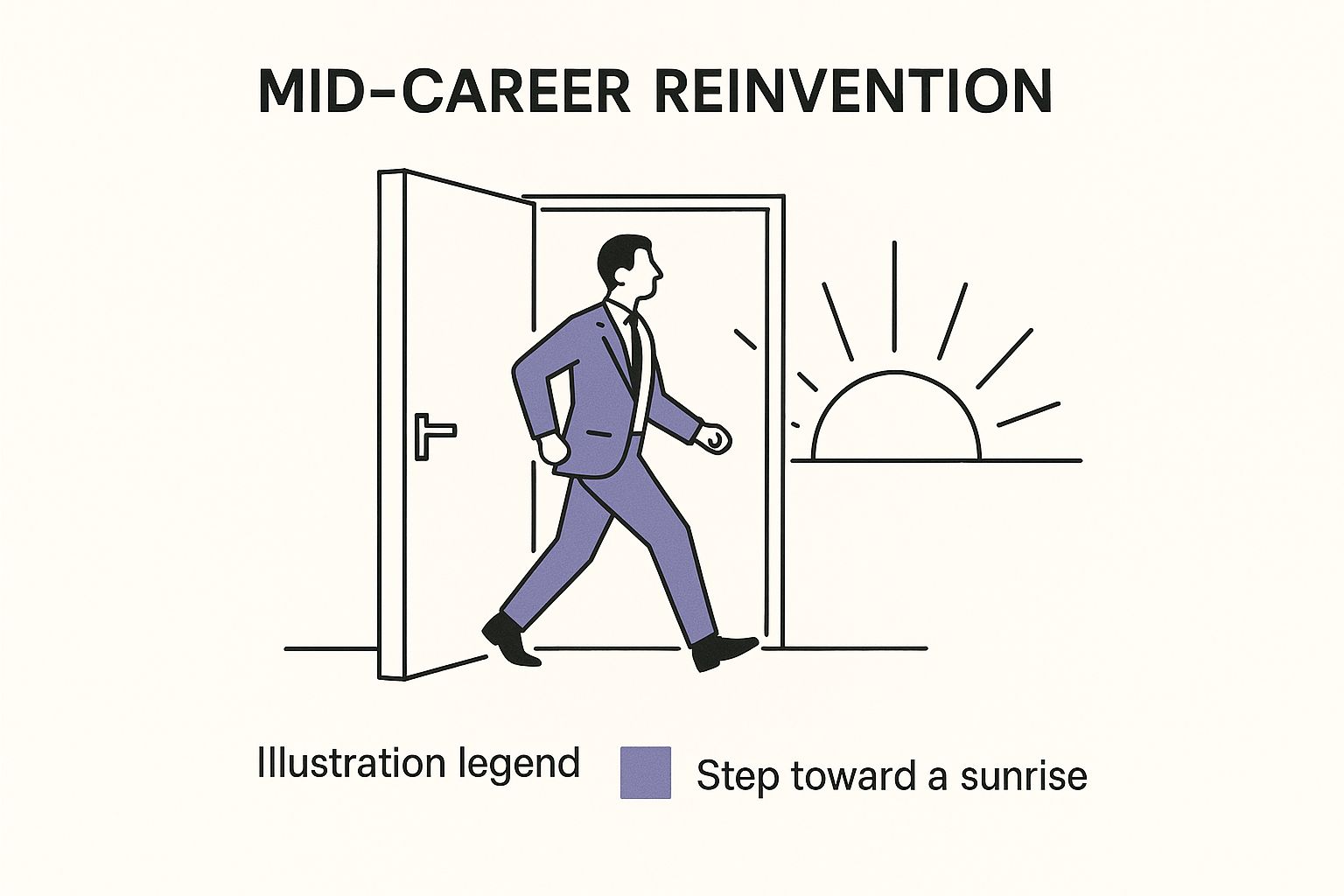
The image says it all: changing careers at 40 is a brave, intentional choice to define what success means on your own terms. Get ready to feel seen, inspired, and excited to begin.
Tapping Into Your Intuitive Career Compass
Before you even think about polishing your resume or starting that endless scroll through job postings, the real work begins. The most powerful step you can take in a career change at 40 happens on the inside.
This is your moment to pause the outside noise and finally tune in to your own internal guidance system. It’s about building your next chapter from the inside out, making sure your next move isn’t just a different job, but a deeply aligned one.
The strongest foundation for a career you love is built on knowing what truly matters to you—your core values, your deepest passions, and your absolute non-negotiables. This has nothing to do with what a job description demands; it’s about what your soul needs to feel alive and on purpose.
Listening to Your Inner Voice
You know that quiet, persistent feeling? That gut instinct that tells you when something is right or wrong, long before your logical mind has a chance to catch up? That’s your intuition. After four decades of life, that inner voice is sharper and wiser than ever. Ignoring it is like trying to navigate a new city without a map.
You don’t need to book a week-long silent retreat to hear it. Just start by creating small pockets of quiet in your day. Even ten minutes of journaling first thing in the morning can create a massive shift.
Not sure where to start? Try pondering these questions:
- When do I feel most energized and alive, both at work and in my personal life?
- What kinds of problems do I actually enjoy solving?
- If money was completely off the table, what would I love to do with my days?
- What were my dreams as a kid, and what parts of them still feel exciting today?
This isn’t about overthinking; it’s about gathering data from your heart. It’s the first real step in learning how to develop your intuition and turning it into a trusted advisor on your career journey.
Distinguishing Intuition from Divination
When we’re searching for clarity, it’s so tempting to look for external signs or a crystal ball to tell us the future. Many people turn to tools like tarot cards or mediumship, hoping for a sneak peek at what’s to come. While these practices can be valuable, their focus is often quite different from what’s needed for a conscious career reinvention.
Tarot, for instance, is brilliant for exploring potential outcomes based on your current path. Mediumship is about connecting with spirits for their messages. Both are forms of divination, which means they focus on getting information from an outside source.
An intuitive reading, however, is a completely different game.
An intuitive reading isn’t about predicting the future. It’s about illuminating your present energetic state and inner truth so you can consciously create the future you desire. It empowers you by helping you hear your own soul’s wisdom more clearly.
Let’s say you feel stuck in a career that drains you dry. An intuitive reading can help pinpoint the energetic blockages or limiting beliefs that are keeping you there. It helps you get clear on what you subconsciously want, revealing a path forward that feels authentic and right on a soul level.
Understanding the different approaches can help you choose the right tool for your career change journey.
Intuitive Readings vs Other Divination Methods
| Method | Primary Focus | Best For | Outcome |
|---|---|---|---|
| Intuitive Reading | Uncovering your inner truth and energetic alignment. | Gaining clarity on your purpose, values, and subconscious desires. | Empowerment and a clear sense of personal direction. |
| Tarot Reading | Exploring potential paths and outcomes based on current energies. | Seeing possibilities and understanding influences around a situation. | Insight into potential futures and situational dynamics. |
| Mediumship | Connecting with spirits for messages from the other side. | Seeking comfort, closure, or guidance from loved ones who have passed. | Messages of reassurance and connection with the spirit world. |
Ultimately, an intuitive reading is about looking inward, while many other methods are about looking outward for answers.
Uncovering Your True Calling with Intuitive Guidance
A professional intuitive reading can be a powerful catalyst for genuine self-discovery. It dives deeper than standard career assessments by tapping into the subtle energies and deep-seated truths that traditional methods almost always miss.
Think of it as having a direct conversation with your higher self, with the intuitive practitioner acting as a clear and supportive translator.
For anyone navigating a career change at 40, this kind of insight is pure gold. You’ve gathered years of experience, but you’ve also picked up a lot of baggage along the way—societal expectations, fears, and beliefs that probably don’t serve you anymore. An intuitive reading helps you sort through it all.
For example, your logical brain might be telling you that a move into management is the obvious next step because it comes with a bigger salary and a better title. But an intuitive session might reveal that your core energy is crying out for more creativity, autonomy, and direct impact—qualities you’d be more likely to find by starting your own consulting business or joining a non-profit.
This isn’t about being told what to do. Far from it. It’s about being handed the map of your own soul so you can choose your next destination with unshakable confidence. By understanding your energetic makeup, you can make choices that don’t just look good on paper but feel profoundly right.
This is the key to creating a second half of your career that is not only successful but also deeply joyful and sustainable. Booking an intuitive reading session with Amy can provide the profound clarity needed to take that first inspired step.
Building the Bridge to Your New Career
Once your intuition has pointed you in a new direction, it’s time to start laying the stones. A successful career change at 40 is a beautiful blend of that inner knowing and smart, practical action. This is where you roll up your sleeves and begin constructing the bridge from where you are now to where you truly want to be.
This whole phase is about intentional strategy. It’s not about erasing the last two decades of your life; it’s about honouring that experience and finding clever ways to repurpose it for your exciting new path. You’ve gathered an incredible wealth of expertise, and now you get to see it all in a new light.

Conducting Your Personal Skills Audit
First things first, let’s take a detailed inventory of what you already bring to the table. A ‘skills audit’ might sound a bit corporate, but it’s really just a deep dive into your professional toolkit. So many of the most valuable skills you have are what we call transferable—they aren’t tied to a specific job title and are desperately needed in almost any industry.
Think about the strengths you’ve been honing for years:
- Leadership and Mentorship: Have you ever guided a team, trained new hires, or just naturally taken the lead on a project? That’s leadership.
- Project Management: Have you managed a project from start to finish? Juggling deadlines, budgets, and stakeholders is a massive skill.
- Strategic Thinking: Are you the person who sees the bigger picture, anticipates problems before they happen, and plans for the future?
- Communication: Can you explain complex ideas clearly, negotiate with clients, or write a compelling email? These are powerful communication skills.
These abilities are the very bedrock of your career. They are the assets you’ve spent 20 years cultivating, and they will be your greatest advantage as you pivot.
Mapping Your Transferable Talents
Once you’ve got a clear list of these core strengths, the next move is to map them to the requirements of your dream career. Start looking at job descriptions for roles that genuinely excite you. What skills are they asking for? I think you’ll be surprised by how much overlap you already see.
For instance, a marketing manager has deep experience in understanding what customers need and crafting persuasive messages. Those are skills that are pure gold in fields like non-profit fundraising, user experience (UX) design, or even wellness coaching. It’s all about reframing what you’ve done.
This isn’t just a passing Canadian trend; it’s a global shift in how we think about work. Here in Canada, changing careers around age 40 is becoming more and more common as our personal priorities evolve. In fact, data shows that Gen Xers, many now in their 40s, typically stay in one job for about 3.4 years—a much higher rate of job switching than previous generations. This reality, combined with accessible retraining programs, makes a mid-career transition more achievable than ever before. You can learn more about Canadian career change trends to see just how common this is.
Your past career wasn’t a detour; it was the training ground. Every challenge you faced and skill you mastered has prepared you for this next chapter.
Creating Your Upskilling Roadmap
Of course, there will probably be a few gaps between your current skill set and what your new career demands. This isn’t a roadblock; it’s simply an opportunity to grow. Your next task is to create a realistic, actionable plan to fill in those gaps.
This doesn’t have to mean going back to university for another four-year degree. Upskilling today can look like a lot of different things:
- Online Certifications: Platforms like Coursera, LinkedIn Learning, or specialized industry bodies offer focused programs you can complete on your own schedule.
- Workshops and Short Courses: Look for intensive workshops that can teach you a specific, high-demand skill in just a few days or weeks.
- Volunteer Work: Offering your time to a non-profit in your desired field is an amazing way to get hands-on experience and start building your network.
- Freelance Projects: Taking on a few small, paid projects can help you build a portfolio and test the waters before you make the full leap.
The key here is to be strategic. Pinpoint the one or two skills that are most critical for getting your foot in the door and start there.
A Real-World Canadian Example
Let’s think about ‘Sarah,’ a 42-year-old marketing manager in Toronto who felt a deep pull to move into the wellness industry. Her corporate job just wasn’t lighting her up anymore, but she was worried all her marketing experience would be irrelevant.
Here’s how she built her bridge:
- Skills Audit: Sarah identified her core strengths in strategic planning, budget management, and creating engaging content.
- Mapping: She quickly realised that wellness studios desperately needed help with brand strategy and building a community—a perfect fit for her background.
- Gap Analysis: The missing piece? She lacked any formal wellness credentials.
- Upskilling Roadmap: Sarah enrolled in an online nutrition coaching certification. While she was studying, she started volunteering to manage the social media for a local yoga studio, letting her immediately apply her new knowledge and build relevant experience.
Within a year, Sarah had crafted a compelling new resume that beautifully blended her two decades of marketing expertise with her new wellness credentials. She successfully landed a role as the Director of Community Engagement for a national wellness brand—a position that perfectly married her past and future. Her journey is a fantastic reminder that a career change at 40 isn’t just a dream; it’s a practical and incredibly inspiring possibility.
Building Your Financial Runway for the Leap
Let’s be honest: money is often the single biggest reason we stay stuck. The fear of financial instability can feel like a brick wall, keeping you from even thinking about a career change at 40.
But what if you could turn that fear into a feeling of empowerment? This isn’t about becoming a world-class penny-pincher. It’s about methodically building a safety net—a financial runway—that gives you the freedom to explore, learn, and make your next move with confidence, not desperation.
Think of it as giving your future self the gift of time and space. With a runway in place, you won’t have to jump at the first offer that lands in your inbox. You can be discerning and hold out for a role that truly aligns with who you are now, not just one that pays the bills.
What’s Your Transition Number?
Before you start saving, you need a target. This means figuring out your bare-bones transition budget. It’s different from your day-to-day budget because it’s stripped down to the absolute must-haves.
For one month, track everything. Get a brutally honest look at where your money is going. Then, you can start sorting expenses into two buckets: non-negotiables and nice-to-haves that can be put on pause for a little while.
Your essential expenses will likely include:
- Housing: Mortgage or rent.
- Utilities: Hydro, heat, water, internet—the basics.
- Transportation: Car payments, insurance, fuel, or transit passes.
- Food: Your realistic monthly grocery bill (not your “aspirational” one).
- Insurance: Any health, life, or other essential coverage.
- Debt Payments: Student loans, credit cards, or lines of credit you have to service.
Once you have that lean monthly number, you’ve found your target. The goal is to save up six to twelve months worth of these essential expenses. That might sound like a lot, but having that cushion is what transforms this journey from stressful to strategic.
How to Build Your Runway Without Grinding to a Halt
Staring at a goal of saving a year’s worth of expenses can feel completely overwhelming. But you don’t have to put your life on hold to get there. It’s all about being creative and strategic.
Some people manage a gradual transition, slowly building skills and savings on the side. Others plan for a full-on career break. There’s no single right way to do it.
Your financial plan isn’t a restriction; it’s your launchpad. It’s the solid ground you build that allows you to take a brave, intuitive leap into your next chapter.
One of the most powerful tools at your disposal is the bridge job. This is a part-time role, a freelance gig, or contract work that keeps cash flowing while you’re upskilling or searching for that perfect full-time position. It might be consulting in your old field or trying out a low-stakes job in an industry that piques your curiosity. It’s all about extending your runway.
Here are a few other smart moves to consider:
- Make the Most of a Severance: If a layoff is part of your story, negotiate that severance package with care. This one-time infusion of cash can be the foundation of your entire runway.
- Use Credit as a Last Resort: A line of credit can be a helpful backup plan, but it’s a safety net, not your primary funding strategy. Don’t rely on it.
- Trim the Big Stuff: Could you get by with one car for a while? Or master a few new recipes to seriously cut down the grocery bill? Small, consistent changes in your biggest spending categories make a massive difference over time.
This part of the process is about making conscious, deliberate choices about your money. When you tackle your finances head-on, you’re not just saving dollars; you’re building the stability and freedom you need to make a truly successful career change at 40.
Networking From the Heart and Rebuilding Your Brand
Your professional network is one of your most valuable assets, but after 40, your approach needs a refresh. Let’s be honest, the word “networking” often conjures up images of stale conference rooms and forced, awkward conversations. It’s time we tossed that idea out the window.
Authentic networking isn’t about collecting business cards or making a desperate plea for a job. It’s about genuine human connection, driven by pure curiosity. Think of it less like a transaction and more like an adventure. You’re not looking for a handout; you’re seeking wisdom, stories, and insights from people who are already lighting the path you want to walk. Shifting your mindset this way is the secret to making connections that not only feel right but also lead to real, exciting opportunities.

Crafting Your New Professional Story
Before you even think about reaching out to anyone, you need to get crystal clear on your own story. A career change at 40 isn’t a setback; it’s a powerful story of evolution and courage. Your job is to craft a personal narrative that beautifully connects the dots between your rich past experience and your future ambitions. This makes your pivot feel not just logical, but incredibly exciting.
Start by digging deep: What’s the common thread that weaves your old career into your new one? Maybe it’s a lifelong passion for solving complex problems, a natural talent for building lasting relationships, or an undeniable drive to make a meaningful impact.
Whatever it is, own it. Your story should never sound like an apology for leaving your old field behind. Frame it with the confidence your experience has earned you.
- Instead of this: “I was completely burned out from my old job, so I figured I’d try something new.”
- Try this: “After two decades honing my skills in strategic planning, I’m thrilled to be applying that expertise to the renewable energy sector, where I can finally contribute to a cause I’m deeply passionate about.”
This narrative is more than just words—it becomes the very foundation of your LinkedIn profile, your resume summary, and every single conversation you have from here on out.
Reaching Out with Purpose and Curiosity
Once your story is solid, you can start connecting with people. The golden rule? Lead with a genuine interest in their journey, not with an immediate ask for yourself.
For Informational Interviews:
Ditch the generic “Can I pick your brain?” message. Be specific, thoughtful, and respectful of their time.
“Hi [Name], I’ve been so impressed by your work at [Company] and your inspiring transition from [Old Field] to [New Field]. As I’m exploring a similar path, I would be so grateful for just 15 minutes of your time to hear about your experience. I’m especially curious about how you translated your project management skills into your new role.”
For Re-engaging Old Contacts:
Don’t just surface after years of silence with a request. That feels transactional. Reconnect on a human level first.
“Hi [Name], it’s been a while! I just saw your recent post about [Topic], and it got me thinking about our time working together on the [Project]. I really hope you’re doing well. I’m actually in the midst of exploring a career shift and would love to catch up and hear what you’ve been up to when you have a free moment.”
Embracing a More Fluid Workforce
This kind of professional mobility is quickly becoming the new normal, especially here in Canada. Federal data shows that Millennials, now between 25 and 40, represent the largest segment of the Canadian workforce at 33.2%. This generation is well-known for its career agility, creating a dynamic job market where changing paths is not just accepted, but often celebrated.
This cultural shift means a career change at 40 places you at a fascinating and powerful intersection of deep experience and fresh perspective. You can discover more about Canadian workforce demographics and trends to see just how much the landscape is evolving in your favour.
Finding Your Mentors and Champions
As you connect with people, look for more than just contacts; keep an eye out for potential mentors and champions.
- A mentor is someone who has walked a similar path and can offer guidance, wisdom, and a much-needed sounding board.
- A champion is someone in your corner who will actively advocate for you, opening doors and making introductions on your behalf.
You won’t find these invaluable relationships by asking for them. You’ll earn them by being a great listener, showing sincere gratitude for people’s time, and always looking for ways to offer value in return. Maybe you can share a relevant article, make a helpful introduction for them, or offer your own expertise on a topic.
Authentic networking is a long game, built on a foundation of mutual respect and shared interests. By focusing on building real relationships, you won’t just find a new job—you’ll build a supportive community that will sustain and inspire you throughout your entire next chapter.
Your Next Chapter Begins Now
Making a successful career change at 40 isn’t just about finding a new job. It’s about weaving together your intuition, smart planning, financial savvy, and the genuine connections you make along the way. Think of it less as a hunt and more as the conscious creation of a life that truly fits the person you are today.
The whole journey starts when you learn to trust that inner voice and back it up with real, tangible action.
Every huge life change is built on a series of small, manageable steps. So, what’s your first one, right now? You don’t need to have everything figured out today.
Your next chapter isn’t something you stumble upon; it’s something you actively create. The power is in this moment, and one small step forward is worth more than the most elaborate plan that never leaves the page.
Take One Inspired Action Today
So, let’s make it real. What’s one thing you can do right now to move the needle, even just a little?
Maybe it’s spending just ten minutes with a journal, sketching out what your ideal workday would feel like. Or perhaps it’s finally researching that one certification that keeps popping into your head. You could even get curious about the subtle nudges you’re receiving by exploring our guide on signs from the universe.
If you’re feeling stuck and need a powerful dose of clarity, booking an intuitive reading can light up the path your soul is nudging you toward.
Don’t wait for the “perfect” time—it doesn’t exist. The moment to begin is now. Your authentic, fulfilling future is ready when you are.
Got Questions About Changing Careers at 40? Let’s Talk.
Making a big career move in your 40s is bound to stir up some questions, maybe even a few late-night worries. That’s completely normal. Let’s get into some of the most common concerns I hear, because getting clear on these things is the first real step toward making a move you feel great about.
Am I Really Too Old to Start Something New?
Let’s just get this one out of the way: absolutely not. This is probably the single biggest myth that keeps talented people feeling stuck.
Think about it. You’re bringing two decades of real-world experience to the table. That’s not a weakness; it’s your superpower. You’ve navigated tricky workplace dynamics, solved problems that aren’t in any textbook, and developed a kind of professional maturity that younger candidates simply can’t offer.
Employers truly value that kind of wisdom and stability. You’re not starting from scratch. You’re making a strategic pivot, leveraging a foundation of strength you’ve spent years building.
How Do I Explain This Shift in an Interview?
It all comes down to telling a great story—your story. The key is to frame your career change not as an escape, but as a conscious, deliberate move toward something that truly excites you.
Your job in that interview is to connect the dots for them. Show them exactly how your years in project management, for instance, perfectly honed the strategic thinking and leadership skills needed for this new role. When you can articulate your journey with passion and self-awareness, your career change becomes a powerful testament to your ambition, not a sign of confusion.
“A powerful career change story isn’t about running from something. It’s about intentionally moving toward your next chapter. It’s a narrative of growth, not just of change.”
Intuitive Readings vs. Traditional Career Counselling—What’s the Difference?
This is a fantastic question, and they actually serve two very different, but equally important, purposes.
Traditional career counselling is brilliant for the practical, nuts-and-bolts stuff. A great counsellor will help you polish your resumé, assess your transferable skills, and pinpoint opportunities in the job market. They give you the “how-to” roadmap.
An intuitive reading, however, gets to the heart of your “why.” It moves past the logical, pro-and-con lists to tap into what your soul is actually calling for. A counsellor helps you find a job that makes sense on paper; an intuitive reading helps you uncover the purpose that will make your work feel deeply fulfilling.
They work beautifully together. The intuitive reading clarifies your true north, ensuring the practical steps you take with a counsellor are all pointed in a direction that genuinely lights you up.
How Do I Handle the Emotional Ups and Downs?
First, know that the emotional rollercoaster is real, and it’s part of the process. Some days you’ll feel on top of the world, and other days, doubt will creep in. That’s okay. The trick is to build a support system before you need it.
- Find your people: Connect with others who have been through a mid-life career change. Hearing their stories is incredibly validating.
- Lean on your inner circle: Let trusted friends and family in on your journey. You don’t have to do this in silence.
- Be kind to yourself: This is a big deal! Celebrate the small wins, and give yourself grace on the days when things feel tough.
Building resilience isn’t about being tough; it’s about knowing you don’t have to go it alone. Every wobble is just part of this incredible transformation.
Feeling that pull toward something more but can’t quite put your finger on it? Amy The Psychic can help you listen to your own inner wisdom. An intuitive reading can offer the clarity you need to finally align your career with your soul’s purpose. Book your session today.