
Trusting Your Inner Compass: A Practical Guide to Developing Intuition
Developing intuition isn’t about some mystical, unattainable gift. It’s about learning to hear the quiet, intelligent signals your mind and body are already sending you every single day.
Think of it as tuning an old radio. At first, all you hear is static—the noise of your to-do list, daily worries, and the outside world’s demands. Yet with patience and practice, you learn to turn the dial just right, tuning into the clear, quiet hum of your own inner wisdom. This journey is about rediscovering a powerful tool you already possess.
Your First Step in Trusting Your Inner Compass
Welcome. If you’re here, you’re ready to start a journey of reconnection. Building intuition is less about learning something new and more about remembering a language you were born with. It’s the art of listening to the rapid, subconscious pattern recognition your mind performs in the background.
Think of it as your internal compass—always pointing toward your authentic North, even when the path ahead looks foggy and uncertain. This isn’t about fortune-telling or guessing lottery numbers. It’s about honouring that subtle nudge to take a different route home, or the inexplicable ease you feel around someone new. It’s the quiet certainty that something is right for you, even when logic argues otherwise.
What Is Intuition, Really?
At its heart, intuition is your subconscious mind working at lightning speed. It sifts through a vast database of experiences, sensory input, and environmental cues, then delivers a conclusion as a “gut feeling” or moment of “knowing.” It bypasses the slow, analytical process of your conscious brain.
This happens constantly, whether you notice it or not. The real skill is learning to distinguish genuine intuitive guidance from mental chatter.
-
Intuition feels calm, neutral, and expansive.
-
Fear and Anxiety are loud, frantic, and constricting.
-
Wishful Thinking feels needy and attached to a desired outcome.
Recognizing these differences is the foundation of self-trust.
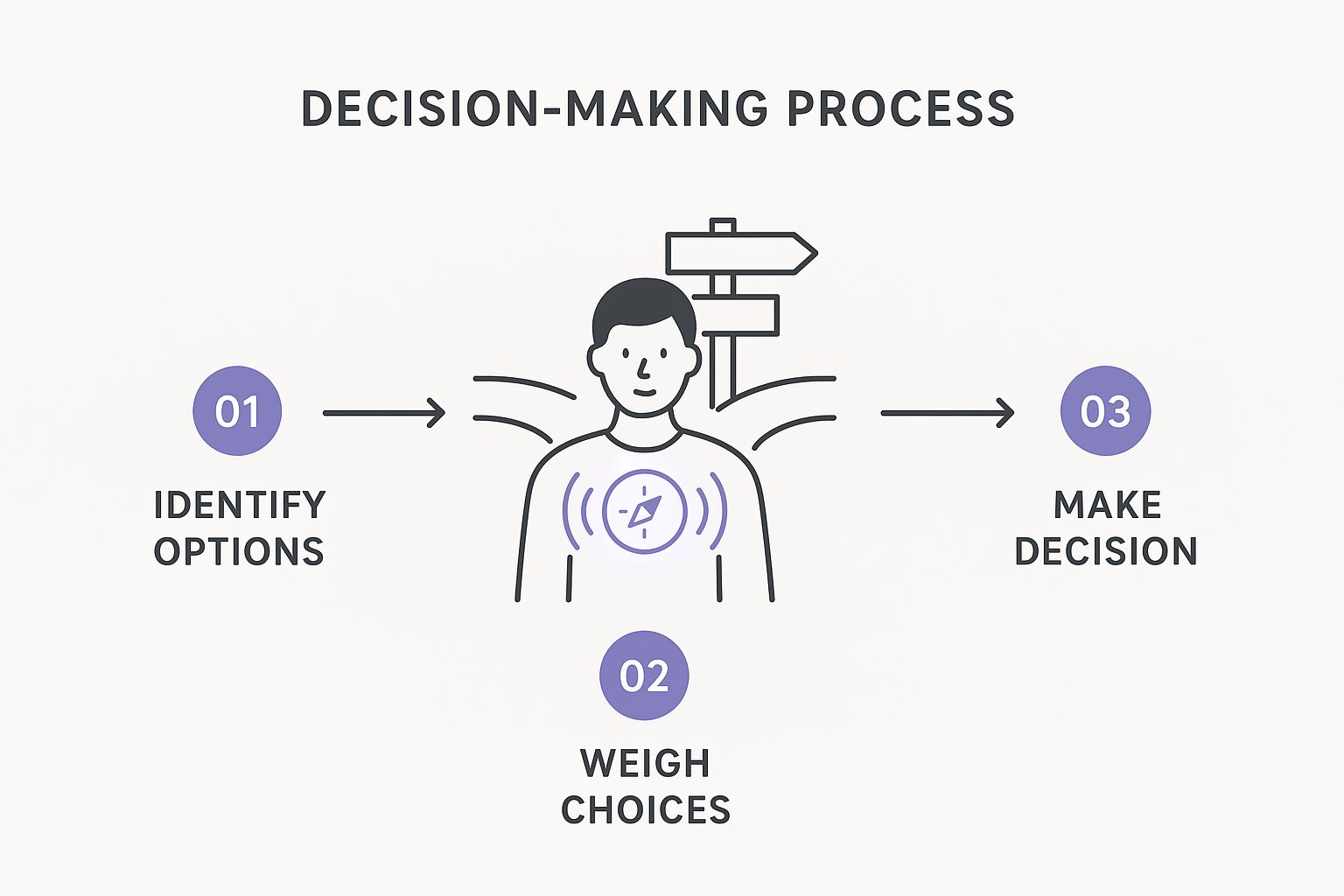
As the image suggests, intuition is a gentle, internal guide—not some booming external force. It steers your decisions from a place of deep, core wisdom.
Building the Foundations for Intuitive Strength
Strengthening your intuitive muscle comes down to practices that heighten self-awareness and sharpen pattern recognition. Interestingly, we can see parallels in modern learning trends. For example, a California survey found that 31.6% of residents use online platforms to build skills in areas like data analytics and UX design.
This shows how people are actively training their brains to process information quickly—a cognitive ability that supports intuition. The goal, however, is not to silence your logic but to balance it. Let your intellect build the boat, and your intuition steer the rudder.
Ultimately, this journey is about creating a deeper relationship with yourself—one where both heart and mind work together with confidence and clarity.
Practical Exercises to Awaken Your Intuitive Senses
Intuition is like a muscle; it strengthens with gentle, consistent practice. These exercises help you learn to hear the quiet whispers of inner wisdom hidden beneath daily noise.
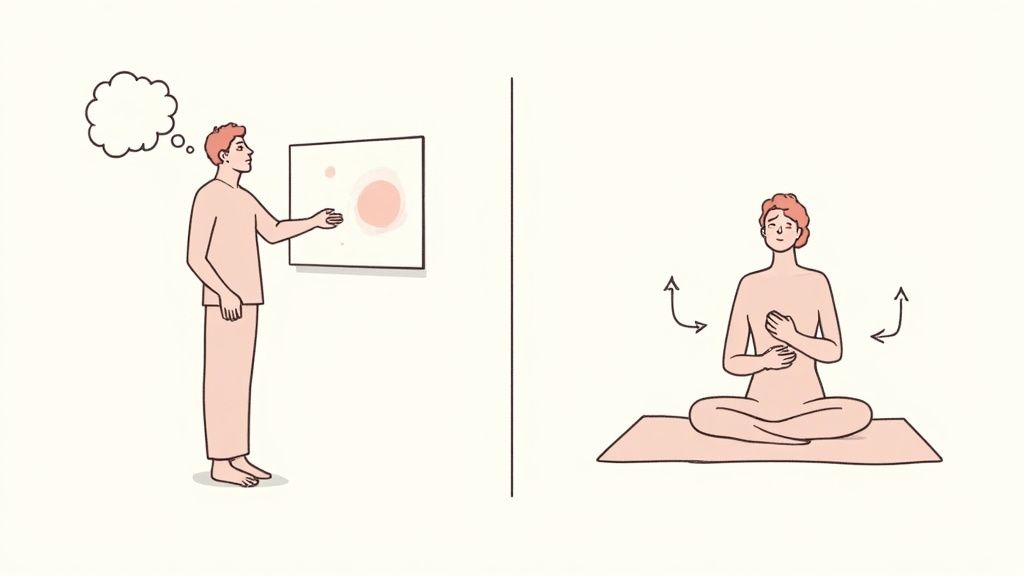
The Body Scan for Intuitive Awareness
Your intuition often speaks through your body. The “knot in your stomach” or “butterflies of excitement” aren’t random sensations—they’re data.
-
Find a quiet place and close your eyes.
-
Bring awareness to your feet, then slowly move upward.
-
Notice sensations in your gut and chest—major communication hubs for intuitive messages.
A sense of tightness or contraction is often a “no.”
Warmth, openness, or expansion usually signals a “yes.”
Practise daily to learn your body’s baseline. That way, you’ll easily recognize intuitive cues when they arise.
The Photo Reading Exercise
This playful technique bypasses overthinking.
-
Choose a photo of someone you don’t know.
-
Look for only three to five seconds—no analysis.
-
Immediately jot down your first impression or feeling.
Then, read the caption or article that accompanies it. You’ll often discover that your initial “hit” reflects the essence of that person’s story.
Your first feeling is intuition.
Your second is logic trying to rationalize it.
Understanding How Intuitive Readings Fit In
As you grow your intuition, you may explore professional guidance. An intuitive reading is a collaborative experience that reflects your inner wisdom back to you—helping you confirm what you already sense.
How Intuitive Readings Compare to Other Methods
| Feature | Intuitive Reading | Tarot Reading | Mediumship |
|---|---|---|---|
| Primary Focus | Tapping into your energy and subconscious for clarity on life paths. | Using archetypal symbolism in tarot cards to interpret possibilities. | Communicating with spirits for healing and closure. |
| Source of Insight | Reader’s direct connection to your energy and higher self. | The cards, interpreted through the reader’s intuition. | Messages from spirits. |
| Best For | Gaining self-awareness and validating your inner guidance. | Exploring complex questions through structured symbolism. | Receiving comfort and closure from loved ones. |
An intuitive reading is empowering—it validates your natural instincts and strengthens self-trust.
If you’re feeling called to explore this area more, our guide on how to develop psychic abilities is a great next step.
Journaling to Track Your Intuitive Hits
Think of an intuition journal as your personal evidence log. It’s how you prove to yourself that your guidance system works.
Write down each hunch, gut feeling, or synchronicity with detail:
-
The Feeling: “Had a sudden urge to call my sister.”
-
The Action: “I decided to call her.”
-
The Outcome: “She was upset and needed someone to talk to.”
Review your entries weekly. Over time, you’ll see undeniable proof of your accuracy—and your confidence will soar.
Creating Space for Your Intuition to Speak
Your intuition is always active, but life’s noise can easily drown it out. Reconnecting requires subtraction—clearing away clutter and distraction.
The Power of Mindfulness and Meditation
Mindfulness is the practice of noticing the present moment without judgment. Meditation strengthens this awareness. Even five minutes of focused breathing—feeling the rise and fall of your chest—can create stillness.
Your mind is like a garden; thoughts will arise, but you can choose which ones to nurture. Meditation is the act of tending that garden, allowing intuitive insights to bloom.
The Art of Unplugging and Finding Silence
Constant digital stimulation keeps your mind in overdrive, muting your intuition. Reclaim your focus with small changes:
-
Create screen-free zones in the morning or before bed.
-
Take a “naked” nature walk—no devices, just presence.
-
Sit in silence for five minutes daily.
Each act turns down life’s static, making your inner signal louder and clearer.
Creating a Receptive Environment
A cluttered space leads to a cluttered mind. Clearing both physical and energetic environments makes intuitive listening easier.
For example, energy-balancing practices such as energy healing can help you maintain clarity and openness. In places like Vancouver, holistic approaches like this are gaining popularity as tools for intuitive development.
Creating space—both internally and externally—is an act of self-respect. It tells your inner wisdom, I’m ready to listen.
Distinguishing Intuition from Fear and Anxiety
One of the most vital skills is telling intuition apart from fear or desire. While they can feel similar, their signatures differ profoundly.
| Quality | Intuition | Fear & Anxiety | Wishful Thinking |
|---|---|---|---|
| Feeling | Calm, neutral, clear | Loud, frantic, repetitive | Excited, attached, outcome-driven |
| Sensation | Open, grounded | Tight, constricted | Restless, anticipatory |
| Focus | Simple truth | “What if” scenarios | Desired result |
| Timing | Arrives once, clearly | Loops repeatedly | Peaks with longing |
Intuition informs; fear agitates.

The Unique Signature of True Intuition
I like to think of intuition as a wise, impartial guide. Its messages are usually straightforward, simple, and don’t come with a heavy emotional backpack. Even when it’s a warning, the feeling behind it is more about clarity than chaos—a simple, solid knowing that something is “off” or just isn’t the right fit.
Fear and anxiety, on the other hand, are loud and messy. They feel frantic, spin in circles, and almost always come with a physical feeling of tightness or panic. Fear shouts, but intuition whispers.
Then there’s wishful thinking. This one feels needy. It’s tangled up with an outcome you desperately want, and it often has an undercurrent of attachment or even desperation. It feels like you’re trying to create a feeling, not just listen to one that’s already there.
Comparing the Voices Within
Let’s get practical and break down the unique personalities of these inner voices. Learning to spot them is the key.
| Quality | Intuition | Fear and Anxiety | Wishful Thinking |
|---|---|---|---|
| Feeling | Calm, neutral, expansive, clear. | Loud, frantic, chaotic, repetitive. | Needy, emotionally charged, attached to an outcome. |
| Physical Sensation | A sense of openness, a gentle nudge, a feeling of “knowing” in your core. | A tight chest, a knot in your stomach, racing heart, feeling of contraction. | Anxious excitement, a “leaning forward” energy, a feeling of lack. |
| Focus | Presents neutral information or a simple truth (“This isn’t the right path”). | Loops on worst-case scenarios and “what-if” questions (“What if I fail? What if they reject me?”). | Fixates on a single desired result (“This has to work out”). |
| Timing | Often arrives as a single, clear “hit” or a quiet, persistent knowing. | It’s a continuous, noisy mental chatter that builds on itself. | It’s strongest when you are feeling a sense of lack or desire. |
Once you start to really tune into these differences, you’ll find you can sift through your internal signals with so much more confidence and accuracy.
Real-World Scenarios and Self-Inquiry
Imagine receiving a job offer:
-
Anxiety says, “What if I fail?” It feels tight and looping.
-
Intuition calmly says, “This doesn’t feel right,” even when everything looks good on paper.
To clarify inner signals, ask:
-
Where do I feel this in my body?
-
Is the message loud or quiet?
-
Does it bring peace or confusion?
Through consistent reflection, you’ll build fluency in your intuitive language.
Weaving Intuition Into Daily Life
True intuitive living isn’t confined to meditation cushions—it thrives in everyday choices. Start small:
-
Let your gut choose your route to work.
-
Ask your body what it really wants for lunch.
-
Notice whether new ideas feel light or heavy.
Each successful moment adds proof to your “intuition file,” strengthening trust over time.
Keep an Intuition Log
Use this structure for each entry:
-
The Feeling: What was the nudge?
-
The Action: Did you follow it?
-
The Outcome: What happened next?
Weekly reflection turns this log into concrete evidence that your intuition works—transforming doubt into trust.
inner wisdom into the chaos and beauty of your everyday life. This is where your intuition comes alive—not in some huge, dramatic flash of insight, but in the small, consistent choices you make from morning to night.
It’s about letting that quiet gut feeling guide you, whether you’re considering a career change, navigating a relationship, or just figuring out what to make for dinner.
The journey to trusting your intuition is really a journey of building a relationship with yourself. And like any good relationship, it’s built on trust. The best way to build that trust is to start small and gather proof. You don’t have to bet the farm on your first intuitive hunch.
Instead, let your gut pick the route you take on your commute. Ask your intuition what your body really wants for lunch, not just what’s easy. When a new idea pops into your head, notice if it feels expansive and exciting, or heavy and draining. Every single time you follow one of these little nudges and it works out, you’re adding a piece of evidence to your collection. You’re teaching your logical brain that this internal guidance system is not only real but reliable.
Keep an Intuition Log
One of the most powerful things I recommend to clients is to start an ‘Intuition Log.’ Think of it as your personal evidence file—a place to track the whispers, the nudges, and the gut feelings, making them tangible and undeniable. It takes your intuition out of the “woo-woo” category and puts it squarely into the “wow, this works” category.
Keep your entries simple, but be specific.
- The Feeling: What was the actual intuitive hit? Was it a clench in your stomach, a sudden clear thought, an image in your mind’s eye? For instance, “Had a sudden, unshakeable feeling I needed to call my sister, even though we just spoke yesterday.”
- The Action: Did you listen, or did you brush it off? “I almost ignored it, but decided to make the call.”
- The Outcome: What was the result? “Turns out, she had just gotten some bad news and really needed someone to talk to. She was amazed I called right at that moment.”
Look back at your log every week or so. Over time, you’ll build an unshakeable confidence in your own inner wisdom that no amount of self-doubt can tear down.
An intuitive reading is a partnership. It’s about amplifying and validating the messages your own soul is already sending you, giving you the clarity and confirmation you need to trust yourself more deeply.
Intuition in Our Modern World
In a world buzzing with notifications and data, how does our intuition fit in? It’s a fascinating question. Take California, for example, where technology is deeply woven into daily life. With over half (50.8%) of all Californians using smart home devices, many of our routine decisions are now outsourced to algorithms.
On one hand, this could free up our mental bandwidth, allowing our intuition to focus on the bigger, more human questions that truly matter. It creates a really interesting dance between data-driven logic and our own innate wisdom. You can dive deeper into these trends and learn how Californians balance technology and personal agency in this fascinating survey.
When You Need a Little More Clarity
As you get better at listening to your intuition, you’ll inevitably hit moments of static. The signals might feel confusing, or a big decision might have you second-guessing everything. That’s completely normal, and it’s often when a little outside perspective can make all the difference.
An intuitive reading with Amy is a guided conversation designed to help you hear your own inner voice more clearly. It’s like having a mirror held up to your soul, reflecting your own wisdom back to you with validation and clarity. It’s a powerful, collaborative step that helps you fine-tune your own intuitive frequency with much greater confidence.
If you feel you’re at a crossroads and need that kind of focused guidance to confirm what your gut is already trying to tell you, consider booking an intuitive reading session with Amy.
Your Questions About Intuition, Answered
As you start this beautiful journey back to yourself, it’s completely normal to have questions pop up. Learning to listen to your intuition is like learning a new language—a few uncertainties are just part of the process. Think of these questions less like roadblocks and more like friendly signposts, guiding you toward a deeper trust in your own inner wisdom.
Let’s walk through some of the most common ones together.
How Long Does It Take to Develop Strong Intuition?
Honestly, this is a lifelong dance, not a race to some imaginary finish line. But the good news? With a bit of consistent practice, most people feel a real shift in their intuitive awareness within just a few weeks. The secret isn’t speed; it’s showing up for yourself regularly.
Even dedicating 10-15 minutes a day to a simple practice like mindfulness or journaling can actively strengthen that intuitive muscle. So, be patient and kind to yourself. The real goal is to become more fluent in your own inner language day by day, not to be perfect overnight.
How Can an Intuitive Reading Help Me?
Think of an intuitive reading as a powerful jump-start for your own development. The point isn’t to look for answers outside of yourself, but to get that “aha!” moment of validation for the feelings and hunches you might have been pushing aside.
Hearing an intuitive practitioner put words to what you’ve been sensing can be a massive confidence booster.
An intuitive reading is like a mirror, reflecting your own inner wisdom right back at you. It’s not about dependency; it’s about using the session to see your own intuitive gifts more clearly.
A good intuitive reading can also help you pinpoint your unique intuitive language—how your body and spirit communicate with you—and give you specific things to focus on in your own practice. It’s a beautiful, supportive tool meant to empower you.
What If I Try These Exercises and Feel Nothing?
If you feel like you’re getting “nothing,” try shifting your focus from the spectacular to the subtle.
- How does your body physically feel when you think about a particular choice? Lighter? Heavier?
- What’s the very first, unfiltered word that pops into your mind? Don’t second-guess it.
- Have you noticed any recurring symbols or subtle signs from the universe showing up in your daily life?
Often, what we think of as “nothing” is actually the quiet, receptive space right before an insight lands. Don’t let it discourage you. Just stay curious, stay open, and trust that the messages are there, waiting patiently for you to notice their gentle presence.
If you’re looking to validate those intuitive nudges and gain more confidence on your path, an intuitive reading can offer the clarity you’re seeking. Book your intuitive reading session with Amy to receive personalized guidance that honours and amplifies your own inner wisdom.
Learning to trust your intuition is really about coming home to yourself. It’s a lifelong dialogue between your heart and mind—one that gets clearer with every act of attention and self-trust. The more you listen, the more your life begins to align naturally with your authentic truth.