
Improving how you communicate in a relationship is about so much more than just talking. It’s about making a conscious choice to understand the energetic exchange that’s always happening just beneath the surface. Real, lasting connection blossoms when you and your partner learn to speak from a place of love and empathy, not react from fear or old wounds.
The Energetic Foundation of Connection
Think about it: true communication is never just an exchange of words. It’s an exchange of energy. If you truly want to learn how to improve relationship communication, you first have to tune into the invisible currents that shape every conversation.
The way you feel on the inside—your stress, your joy, your unspoken intentions—colours the message your partner receives, often more powerfully than the words themselves. It’s the difference between saying “I’m fine” with a relaxed posture and a soft smile, versus saying those exact same words with clenched fists and a tight jaw. The words are identical, but the energy couldn’t be more different.
This energetic signature is what can turn a potential argument into a genuine opportunity for growth. When you shift your communication from a place of fear—fear of being misunderstood, abandoned, or judged—to one of love, you create a safe space where vulnerability and honesty can thrive. Communicating from love means your core intention is to understand and connect, not to win an argument or prove you’re right.
From Fear to Love in Conversations
Making this shift isn’t always easy; it takes a healthy dose of self-awareness. Before you speak, especially during a tense moment, take a breath. Check in with yourself. Are you feeling defensive? Anxious? Resentful? If so, your words will carry that heavy, charged energy, and you’ll almost certainly trigger a defensive response in your partner. This is exactly how so many couples get stuck in those frustrating, repetitive arguments that go nowhere.
Putting in this conscious effort is absolutely essential. Research consistently shows that positive interactions tend to dip as relationships mature unless couples actively work on them. A 2021 study, for instance, found that both positive communication and overall relationship satisfaction can decrease over time, while negative communication patterns tick upward. This really highlights why we have to actively nurture the way we connect. You can read the full research about these relationship dynamics to get a deeper understanding.
To really see what a difference this makes, let’s look at the contrast between these two approaches.
Shifting Your Communication Energy
This table breaks down the subtle but powerful differences between communicating from a place of fear versus a place of love. It’s a roadmap for transforming your interactions.
| Fear-Based Communication (What to Avoid) | Love-Based Communication (What to Cultivate) |
|---|---|
| Focus: Being right, winning the argument, defending your ego. | Focus: Understanding your partner, finding common ground, nurturing the bond. |
| Tone: Accusatory, critical, defensive, or dismissive. | Tone: Curious, compassionate, open, and validating. |
| Language: “You always…” or “You never…” statements. | Language: “I feel…” or “My perspective is…” statements. |
| Goal: To control the outcome or avoid personal vulnerability. | Goal: To foster connection, safety, and mutual respect. |
| Listening: Waiting for your turn to speak; formulating your rebuttal. | Listening: Genuinely hearing what is being said (and what isn’t). |
| Underlying Emotion: Anxiety, insecurity, resentment, or a need for power. | Underlying Emotion: Trust, empathy, security, and a desire for partnership. |
By consciously choosing the path of love-based communication, you’re not just avoiding a fight; you’re actively building a stronger, more resilient, and more intimate relationship, one conversation at a time.
This chart below perfectly illustrates the powerful impact that positive habits, like active listening, can have on the health of your relationship.
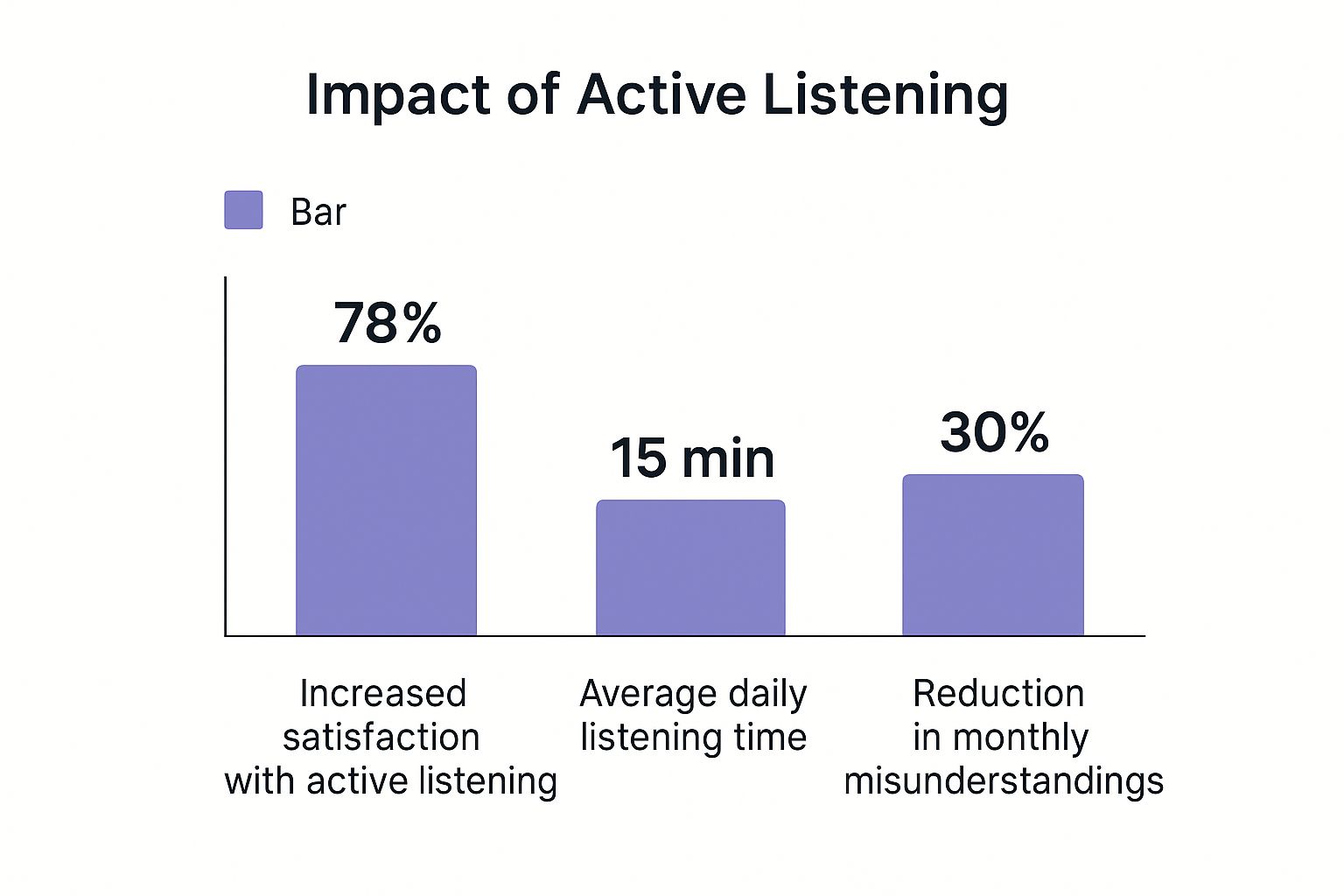
The data here is crystal clear: even small, consistent efforts in how you listen can lead to huge improvements in relationship satisfaction and a massive reduction in misunderstandings. When you start focusing on the energetic quality of your interactions, you build a foundation of trust and empathy that deepens your bond right down to a soul level.
The Art of Listening Beyond Words
We’re often told that good communication is about speaking clearly, but I’ve found the real magic starts when we learn to truly listen. It’s a concept that goes far beyond just hearing the words someone says. To really connect and improve communication in our relationships, we need to learn how to listen with our whole being—our heart, our mind, and our intuition.

This kind of deep listening creates a palpable sense of safety. It’s an energetic space where your partner can finally let their guard down, knowing they will be fully seen and heard without judgment. It’s not about processing information or preparing your rebuttal; it’s about receiving their emotions, validating their experience, and sensing the unmet needs that often hide just beneath the surface.
The goal is to quiet your own inner chatter—that voice that’s already jumping ahead, figuring out a solution or a counter-argument. Just be present.
When someone feels genuinely heard on that level, it builds a foundation of profound trust. It’s a powerful way of saying, “Your inner world matters to me more than being right or fixing this.”
Tune Into the Unspoken Language
Let’s be honest, so much of what we actually communicate isn’t verbal at all. The real story is often tucked away in the tone of voice, a fleeting look in their eyes, or a subtle shift in posture. Listening with your intuition is all about tuning into these powerful, non-verbal cues.
Think about it. Your partner comes home from a long day and, when you ask how it was, they say, “Work was fine.” But you notice their shoulders are slumped and their energy feels heavy. A surface-level listener might just take the words at face value and move on.
But an intuitive listener senses the gap between the words and the feeling behind them.
This is your moment. It’s an opportunity to gently open the door to a real connection. Instead of just accepting their answer, you could say something like, “It sounds like it was a really long day. I’m here if you feel like talking about it.” This simple act acknowledges the unspoken emotion and shows you’re paying attention, creating that all-important sense of safety.
“True listening requires a setting aside of oneself. And that can be hard to do. When we are fully present with another person, we offer the greatest gift of all: our undivided attention and our open heart.”
This small shift in your approach can transform potential misunderstandings into moments of deep connection. It’s a cornerstone of what experts on emotional intelligence talk about—our ability to perceive and understand others’ emotions is what helps us build strong, resilient relationships and navigate tough conversations with grace.
Practical Steps for Soulful Listening
Listening is a skill, and like any skill, it gets stronger with intentional practice. It’s all about showing up for your partner in a way that makes them feel safe enough to be truly vulnerable. Here are a few ways to start cultivating this deeper form of listening in your own life:
- Silence Your Inner Advisor: This is a big one. Make a conscious choice to just listen without trying to fix anything. So often, people don’t want solutions; they just want to feel understood. Let them get their entire thought out without jumping in.
- Listen for Feelings, Not Just Facts: Behind every story, there’s an emotion. Try to identify what they’re really feeling. Is it hurt? Frustration? Fear? Naming that feeling can be incredibly validating. For example, “It sounds like you felt really alone in that moment.”
- Practice Reflective Validation: Go a step beyond simply repeating what they said. Instead, reflect back the emotional core of their message. Saying something like, “I can hear how upsetting that must have been for you,” shows you’re connecting with their experience, not just the details of their story.
By listening beyond the words, you’re doing so much more than just improving communication. You’re actively nurturing the soul of your relationship, showing your partner that every part of them—their thoughts, their feelings, and their fears—is welcome with you.
Expressing Your Truth With Compassion
Once you’ve mastered the art of listening from the heart, the other side of the coin is learning to share your own authentic feelings. This is where so many of us stumble. It’s not about winning an argument or proving you’re right; it’s about sharing your truth in a way that actually builds a bridge to your partner, rather than putting up a wall.
How you share your experience makes all the difference. It’s the deciding factor between your partner truly hearing you and them immediately shutting down.

The real goal here is mutual understanding, not assigning blame. When you can speak from a place of compassion, you’re honouring your own needs while also respecting your partner. It’s a gentle yet firm approach that can turn a dreaded conversation into a genuine moment of connection.
This isn’t just feel-good advice, either. Research consistently shows that hostile and stonewalling behaviours are huge red flags, often predicting aggression and deep dissatisfaction down the road. By intentionally choosing warmth and connection over criticism, you’re actively building a more resilient and fulfilling partnership. You can read more about how communication patterns impact relationships on PMC.
Own Your Experience With “I” Statements
One of the most powerful and immediate shifts you can make is switching to “I” statements. Think about it: when someone starts a sentence with “You always…” or “You did…”, doesn’t it feel like an attack? It instantly puts you on the defensive.
Flipping the script to start from your own perspective changes the entire energy of the conversation.
- Instead of: “You never help around the house.”
- Try this: “I’ve been feeling really overwhelmed and unsupported when the chores pile up.”
- Instead of: “You weren’t listening to me.”
- Try this: “I feel unheard when I’m trying to share something that’s important to me.”
Using “I” statements isn’t about being weak or passive. It’s about being incredibly clear and taking ownership of your feelings. You get to express a need or a hurt without assassinating your partner’s character, which makes it infinitely easier for them to respond with empathy instead of a counter-attack.
Tune Into Your Intuition Before You Speak
Hold on. Before you even open your mouth, just pause. Take one deep breath and connect with that quiet voice inside. Ask yourself: what is my real intention here? Am I just looking to vent my frustration, or do I want to create a solution that works for both of us?
Your intuition is a brilliant guide, helping you find the right words that align with your deepest desire for the relationship.
By speaking from a place of intuitive clarity and compassion, you invite your partner to solve the problem with you, rather than making them the problem you’re fighting against.
This quick internal check-in is foundational. When your words come from a place of connection, you set the stage for a conversation that heals rather than harms. If you’re looking to strengthen that connection to your inner wisdom, our guide on how to develop psychic abilities can be a powerful way to deepen your self-awareness.
Ultimately, this practice helps you communicate not just what’s on your mind, but the real truth of your heart.
Navigating Conflict with Grace
Let’s be real: disagreements happen. They aren’t a sign that your relationship is on the rocks; in fact, they’re a totally normal, unavoidable part of sharing your life with someone. The secret to learning how to improve relationship communication is to stop seeing conflict as a battle to be won.
Think of it instead as an opportunity. Every argument is an invitation to understand your partner—and yourself—on a much deeper level. When you approach these moments with grace instead of fear, you can turn that painful friction into a chance to heal old patterns and build an even stronger connection.
Ground Yourself in the Storm
When emotions are running hot, it’s so easy to get swept away. Your heart starts pounding, your mind races, and suddenly you’re in full-on fight-or-flight mode. The most powerful and loving thing you can do right then is to stay grounded.
Before you say a word, just pause. Take one single, deep breath. That tiny moment creates a sliver of space between the trigger and your reaction, and that space is where your power is. It gives you the chance to choose a response that comes from love, not from a knee-jerk need to defend yourself.
It takes incredible strength to know when you’re too emotionally flooded to have a productive conversation. Sometimes, the best move is to say, “I really need a break. Can we pick this up in twenty minutes?” This isn’t about running away from the problem; it’s a smart strategy that respects your own well-being and the health of your relationship.
Look Beneath the Surface of Arguments
Do you ever find yourselves having the same argument over and over? It’s probably not about the unwashed dishes or the forgotten anniversary. Those are just the symptoms. Recurring fights almost always point to a deeper, unmet need or an old wound that’s been poked.
By shifting the focus from proving who is right to solving the problem together, you step out of a power struggle and into a true partnership. The question becomes, “How can we, as a team, address this underlying issue?”
This small change in perspective can completely dissolve the tension that makes conflict feel so awful. It turns a battlefield into a workshop, where the two of you can build solutions that work for both of you. But to do that, you have to recognize the patterns that pull you apart.
Conflict Resolution Approaches
Let’s look at some of the common destructive habits we can fall into during a fight, and compare them to healthier, more constructive alternatives. This isn’t about blame; it’s about awareness.
| Destructive Pattern | Impact on Relationship | Constructive Alternative |
|---|---|---|
| Criticism and Blame | Creates defensiveness and chips away at your partner’s self-esteem. | Gentle Start-Up |
| Stonewalling (Shutting Down) | Signals emotional abandonment and can cause deep, lasting hurt. | Physiological Self-Soothing |
| Defensiveness | Heats up the conflict because you’re refusing to own any part of the problem. | Taking Responsibility |
| Contempt (Sarcasm, Mocking) | Shows disgust and is the single biggest predictor of a breakup. | Expressing Needs and Admiration |
When you actively choose these constructive alternatives, you are choosing connection over conflict, every single time. It’s how you learn to move through disagreements with grace, turning every challenge into a new opportunity to deepen your love and understanding for one another.
How Intuitive Readings Illuminate Your Path
Have you ever felt like you’re just too close to a problem to see it clearly? When you and your partner find yourselves stuck in the same frustrating communication loop, it’s often a sign of something deeper—energetic roots that are almost impossible to see on your own. This is where taking a step back to gain a higher perspective isn’t just helpful; it’s essential for any real breakthrough.

An intuitive reading with Amy offers a truly unique way to light up the path forward. It provides that high-level, energetic view of your relationship dynamics that everyday conversations just can’t reach.
Seeing Beyond the Surface
When people think of spiritual guidance, their minds often jump to psychic predictions or tarot readings focused on what the future holds. And while those are incredibly insightful tools, an intuitive reading works a little differently. It’s less about predicting what’s going to happen and far more about deeply understanding the present moment on a soul level.
Amy’s intuitive approach connects directly with the energetic blueprint of your relationship. This allows her to perceive the hidden blockages, the unspoken emotional needs, and even the karmic patterns that are quietly shaping every single interaction you have with your partner. It’s like someone finally flipping the light switch in a dark room—all at once, you can see the obstacles you’ve been tripping over.
The greatest gift an intuitive reading offers is clarity. It reveals the ‘why’ behind your communication struggles, transforming confusion and frustration into a compassionate understanding of your shared dynamic.
When you finally grasp the root cause of an issue, your entire perspective can shift. Suddenly, it’s not about who’s right or wrong anymore. It’s about recognizing a pattern that you can finally heal together. If you’re curious about different approaches, you can explore more about the power of tarot in relationships in our detailed guide to see how various tools can offer their own unique insights.
Turning Insight Into Action
This newfound clarity is incredibly empowering. Once you understand the energetic source of your communication struggles, you can approach your partner with a depth of empathy and patience that might have felt impossible before.
An intuitive reading can help you:
- Identify Energetic Mismatches: You’ll discover where your energies might be clashing and learn how to create a more harmonious flow between you.
- Uncover Unspoken Needs: Finally hear what your partner’s soul is asking for, even when they can’t find the right words to say it themselves.
- Recognize Past Influences: See how past experiences or even karmic ties might be impacting your ability to connect deeply in the present.
Armed with these insights, you’re no longer just reacting blindly to surface-level arguments. Instead, you can begin using heart-centred communication strategies that get to the real issue. This is how you stop having the same fight over and over and start creating real, lasting change. By gaining that soul-level perspective, you’re given a clear and actionable roadmap to navigate your relationship with renewed grace, wisdom, and love.
Cultivating Daily Rituals for Connection
Great communication isn’t just a tool you pull out when there’s a problem. It’s the quiet, everyday stuff that really builds a strong partnership. The most resilient and loving relationships are built on small, consistent moments of connection that weave a foundation of trust and intimacy, day in and day out.
Think of it as making connection a daily habit, not just a crisis management strategy.
These rituals don’t have to be grand, time-consuming gestures. One of the most powerful things you can do is a simple daily “check-in.” Just a few uninterrupted minutes where you and your partner share how you’re really feeling. It’s not about fixing anything; it’s about listening and simply holding space for each other’s inner world. That’s what makes you feel like a true team.
The Power of Non-Verbal Connection
We often get so caught up in words that we forget the quiet magic of touch and presence. Never underestimate the power of non-verbal cues. A long, intentional hug when you get home, holding eye contact across a crowded room, a gentle touch on the arm as you pass by—these small acts can say more than a thousand words.
These moments speak a language all their own, reaffirming your bond on a primal, energetic level. They’re a constant reminder that you are seen, cherished, and safe. If you’re curious about deepening this energetic awareness, exploring practices like intuitive energy healing can open up a whole new understanding of these subtle, powerful connections.
Carving Out Sacred Space
Another game-changer is scheduling a regular “relationship review.” It sounds formal, but it’s really just a gentle, dedicated time to talk about what’s going well and what could feel even better. This is how you stay ahead of issues, making sure small resentments don’t have a chance to grow. The key is to keep the focus on appreciation and teamwork, not on pointing fingers.
“These small, consistent investments in your connection are what build a resilient foundation of trust. They make the difficult conversations much easier to navigate when they inevitably arise because you’re starting from a place of deep-seated understanding and goodwill.”
This proactive approach of aligning on core values isn’t just for established couples. A recent survey on dating trends found that 59% of women now prioritize emotional dependability, sparking deep conversations early on to “future-proof” their new connections. Learn more about these evolving communication trends on sandiegomagazine.com.
By weaving these simple practices into your life, you aren’t just maintaining your relationship—you are actively co-creating a partnership that feels safe, seen, and deeply connected, every single day.
Your Questions, Answered
Embarking on a journey to deepen your connection is incredible, but it’s natural to have questions pop up along the way. Let’s tackle some of the most common ones I hear from couples looking to truly hear each other again.
What’s the biggest communication mistake most couples make?
Hands down, the most common pitfall I see is listening with the intent to reply, not to understand. It’s almost a reflex, isn’t it? As your partner is talking, your mind is already racing, building your counter-argument or your defence.
When you’re stuck in that mode, you miss the real message—the emotion and the need hiding beneath their words. The moment you shift your focus to simply hearing their perspective, without judgment or planning your rebuttal, you change the entire energy of the conversation. It stops being a battle and starts being a collaboration.
How can we possibly communicate better when we’re both completely stressed out?
This is a big one. When life feels overwhelming, communication is often the first thing to suffer. The key here is to be intentional and realistic about your own emotional capacity.
Recognise when you’re both running on empty and agree to table important conversations until you have more to give.
A “soft start-up” can be a relationship-saver in these moments. Instead of diving in, try saying something like, “I know we’re both exhausted, but something has been on my mind. When would feel like a good time to talk about it?” This simple question honours both your feelings and prevents a minor issue from blowing up because of sheer exhaustion.
Can an intuitive reading actually help our communication?
Absolutely. An intuitive reading can offer a perspective that you simply can’t get when you’re in the thick of it. Think of it this way: you and your partner are on the ground floor, navigating the day-to-day maze of your dynamic. An intuitive reading with Amy takes you to the rooftop, showing you the energetic patterns and blockages that are causing all those frustrating miscommunications.
It’s not about predicting the future. It’s about illuminating the invisible forces shaping your present. Gaining that clarity often brings a flood of compassion for both yourself and your partner, allowing you to finally address the root of the problem instead of just endlessly reacting to the symptoms.
Ready to see your relationship from that higher perspective? Amy The Psychic can reveal the energetic patterns that are holding you back. You can book an intuitive reading session at https://amysintuitivecommunity.com.