
In a world that never seems to quiet down, finding a sense of inner peace can feel like a distant dream. It’s a personal journey, one that asks you to turn your focus inward, away from the constant noise, and get to know the landscape of your own heart and mind.
This isn’t about chasing some fleeting moment of bliss. It’s about building a solid foundation of calm you can return to, time and time again, by connecting with your intuition and embracing mindful practices.
Finding Stillness in a World of Noise

Does life feel like it’s pulling you in a million directions at once? It’s a common feeling. The quest for how to find inner peace can seem almost impossible when you’re navigating a storm of work deadlines, family needs, and the endless scroll of social media.
This guide is different. We’re going to skip the quick fixes and surface-level tips. Instead, think of this as your starting point for cultivating a deep, lasting sense of calm that radiates from your core. Real peace isn’t about living a perfect, stress-free life; it’s about learning to move through life’s inevitable storms with a little more grace and a lot more clarity.
The Growing Need for Calm
Let’s be honest—the struggle for mental wellness is real, and it’s growing. Just look at California, where an eye-opening 94% of young people say they face regular mental health challenges. Stressors like the high cost of housing and the fear of gun violence are chipping away at their sense of safety and well-being. It’s a powerful reminder of how tough it is to find peace when the world outside feels so heavy. You can read the full details of this youth mental health crisis in the report.
This journey is about building that inner sanctuary by:
- Truly understanding and accepting your inner world, emotions and all.
- Weaving simple, practical moments of mindfulness into your day.
- Learning to trust the quiet guidance of your own intuition.
Inner peace isn’t the absence of chaos, but the ability to remain calm within it. It’s an active practice of returning to your centre, moment by moment.
When you start to focus on these areas, something incredible happens. The external noise begins to fade, and you can finally hear the profound wisdom you’ve carried all along. Practices designed to support this journey, like those focused on energy healing in Vancouver, can be wonderful for helping to clear the internal clutter that holds you back. Ultimately, the goal is to empower you to find your own answers and build unshakeable resilience from the inside out.
Start by Understanding Your Inner Landscape
True inner peace isn’t about silencing your mind or forcing yourself to feel happy. It’s about getting to know the person you already are, right now. Think of it like starting any great adventure—the first step is always figuring out where you are on the map. This means learning to simply observe your inner world—your thoughts, feelings, and memories—without getting tangled up in them.
I like to think of my mind as a vast, open sky. Thoughts and feelings are just clouds passing through. Some days they’re light and wispy, other days they’re dark and stormy. The real work isn’t to control the weather, but to remember that you are the sky itself, always there behind the clouds. This one simple shift in perspective can be the bedrock of a truly lasting peace.
Acknowledging the Past with Compassion
A lot of the internal static that robs us of our calm comes from experiences we haven’t fully processed. Our past, especially our childhood, has a quiet way of shaping our reactions and beliefs in the present. This isn’t about getting stuck in history; it’s about gently acknowledging how it’s showing up for you today.
Making those connections is a massive step toward healing. For instance, adverse childhood experiences (ACEs) can be a significant source of ongoing distress. In California, we see that people with four or more ACEs are far more likely to face mental health challenges. The data also shows that Black (24.9%) and Latino (23.0%) adults report these experiences at higher rates than White adults (18.4%), reminding us that past trauma creates very different paths for different people. You can explore more about these findings and their impact.
Using Journaling to Map Your Thoughts
Journaling is one of the most powerful and practical tools I know for charting this inner territory. It gives you a safe space to meet your thoughts on the page, helping you see patterns you might otherwise miss. Forget about perfect grammar or beautiful prose. Just be honest.
If you’re not sure where to start, try these simple prompts:
- Morning Check-In: “What’s here for me as I start my day?” This gives you a snapshot of your baseline mood before the world rushes in.
- Emotional Trigger Log: “When did I feel that pang of anxiety or flash of anger today? What was happening right before?” This helps you become a detective, linking situations to your emotional responses.
- Pattern Recognition: “What’s a thought that keeps looping in my mind this week? Where do I think it’s coming from?” This is where you can start digging a little deeper into the roots of those repetitive mental habits.
By observing your inner world with gentle curiosity instead of harsh criticism, you begin to untangle the knots. This practice is what allows you to respond to life with intention, rather than being pulled along by old, unconscious reactions.
Tune Into Your Intuition for Unshakeable Guidance
Have you ever had a gut feeling you just couldn’t ignore? That quiet, inner voice is your intuition, and it’s one of the most powerful tools you have for navigating life. The problem is, the noise of the outside world—and our own busy minds—can easily drown it out, leaving us feeling uncertain and disconnected.
Learning to find your inner peace is really about learning to listen to that inner compass. It’s about getting good at telling the difference between its calm, steady whisper and the frantic shouts of fear or ego.
Finding Your Path to Insight
When we feel lost, it’s natural to look for answers outside of ourselves. Practices like tarot readings or mediumship can offer perspective, but they serve a different purpose than building your own intuitive strength.
It’s helpful to understand what each tool is designed for so you can choose what truly supports you on your journey.
- Tarot Readings: Tarot cards use powerful, universal symbols to mirror your current energy and explore potential outcomes. They’re fantastic for getting unstuck or seeing a situation from a new angle.
- Mediumship: This is about connecting with loved ones who have passed on. People often seek out mediumship for a sense of closure and comfort.
- Intuitive Readings: This is different. The goal here isn’t just to get an external answer, but to empower you to find your own answers. It’s a process designed to connect you directly with your higher self and strengthen your ability to hear and trust your inner wisdom.
While other methods can provide valuable external guidance, an intuitive reading focuses on turning your attention inward. It helps you build the self-trust that is the absolute foundation of lasting inner peace.
This infographic breaks down the core practices for building the self-awareness you need to hear that inner voice clearly.
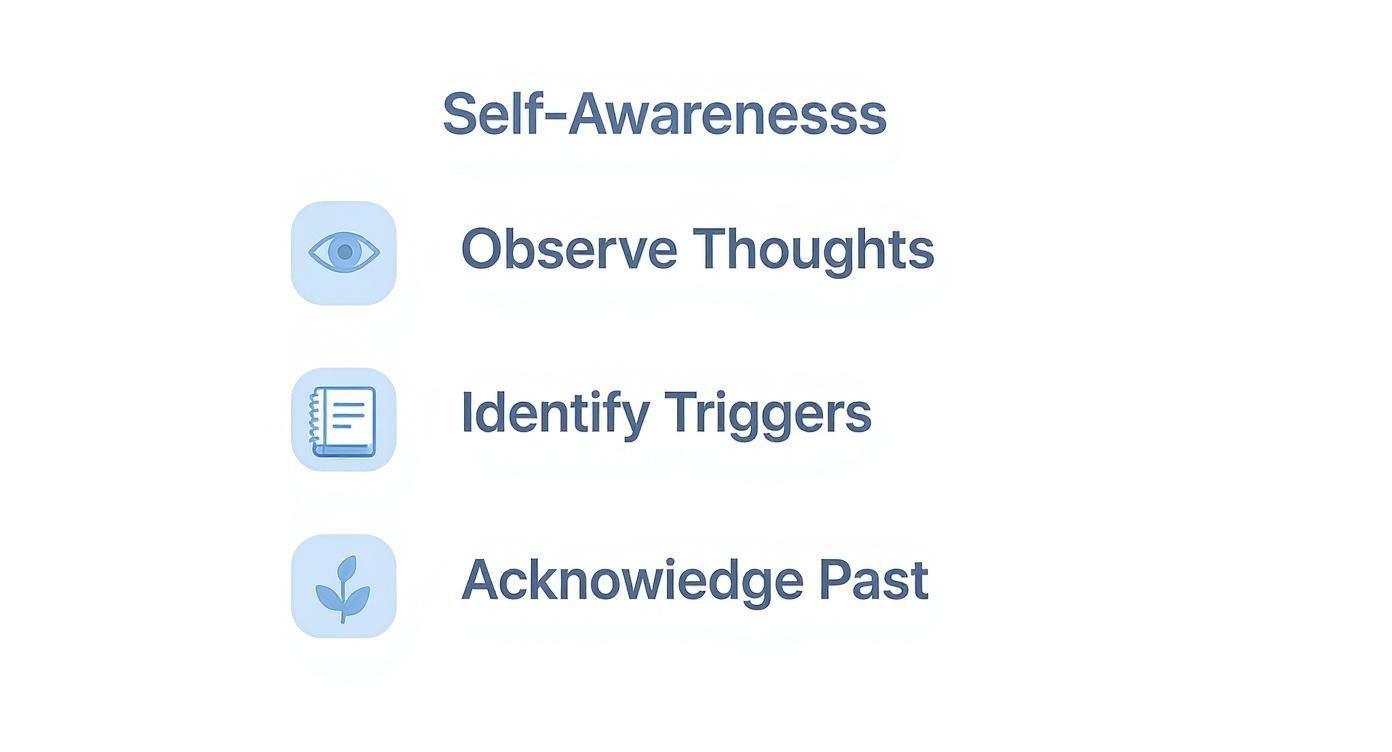
Mastering these three pillars—observing your thoughts, identifying what triggers you, and acknowledging your past—is how you start clearing away the mental clutter that gets in the way of your intuition.
To help you decide which path feels right for you, here’s a quick look at how these methods compare.
A Comparison of Different Insight Methods
Understand the purpose of different guidance tools to find what best supports your journey toward inner peace and self-trust.
| Method | Primary Focus | Best For |
|---|---|---|
| Tarot Reading | External perspective and archetypal patterns | Gaining clarity on a specific problem or decision. |
| Mediumship | Connecting with spirits | Seeking comfort or closure from loved ones who have passed. |
| Intuitive Reading | Strengthening your own inner wisdom | Empowering you to trust your own guidance and find your answers. |
Ultimately, each practice offers a unique lens. The key is to choose the one that aligns with your intention—whether that’s getting an external viewpoint or building your own internal compass. An intuitive reading is specifically designed for the latter.
Learning to Hear Your Inner Wisdom
Your intuition rarely shouts. It speaks in subtle nudges—a feeling in your stomach, a sudden flash of insight, or a simple sense of “rightness” about a choice. The more you consciously pay attention to these feelings, the louder and clearer they will become.
If this feels new to you, don’t worry. It’s a skill you can develop. Our guide offers some wonderful, practical exercises on how to develop intuition that can help you take those first steps.
The most profound answers you seek are not “out there” somewhere. They are already inside you. An intuitive reading simply helps you build the bridge from a place of questioning to a place of deep inner knowing and confidence.
This is about taking your power back. When you learn to rely on your own internal guidance system, you stop needing so much validation from the outside world. You become anchored in your own truth.
And it is from this centered, confident place that a genuine, unshakable inner peace finally has the space to grow.
Everyday Mindfulness for Immediate Calm

The path to inner peace isn’t paved with week-long silent retreats or hours of meditation—not for most of us, anyway. Real, sustainable calm is forged in the small, quiet moments you carve out for yourself in the middle of a hectic day. It’s about finding your footing right where you are, using simple, practical tools to pull yourself back to the present moment.
Think of this not as adding more to your plate, but as changing the way you approach the moments you already have. By weaving these tiny pockets of mindfulness into your daily rhythm, you start to build a powerful buffer against stress, creating a more centred and resilient foundation for your life.
Ground Yourself with the 5-4-3-2-1 Method
You know that feeling when anxiety suddenly hits? Maybe it’s right before a big presentation or during a tense conversation, and your mind just starts spinning. The 5-4-3-2-1 grounding technique is my go-to for moments like that. It’s an incredibly simple but powerful way to yank your awareness out of that mental storm and plant it firmly back in the real world.
The magic is in how it engages all your senses, anchoring you in your physical surroundings. You can do this anywhere, anytime.
Here’s the breakdown:
- Notice 5 things you can see: Let your eyes wander. Name five separate objects you see. Don’t just list them; notice their colour, the way the light hits them, their shape. A blue pen, a crack in the ceiling, a wilting plant.
- Notice 4 things you can feel: Bring your attention to physical sensations. It could be the solidness of the floor under your feet, the soft texture of your sweater against your skin, or the cool metal of your watch.
- Notice 3 things you can hear: Listen. What sounds can you pick out? Maybe it’s the distant hum of traffic, the quiet whir of your computer, or the sound of your own breathing.
- Notice 2 things you can smell: What’s in the air? It could be the faint aroma of stale coffee, the clean scent of hand soap, or even just the neutral smell of the room.
- Notice 1 thing you can taste: Focus on the inside of your mouth. Is there a lingering flavour from your last meal? Or maybe just the simple taste of… well, you.
This sensory inventory acts like a circuit breaker for anxious thoughts. It gives you immediate relief and a clear path back to a calmer state of mind.
Embrace the Power of Single-Tasking
In a world that celebrates doing a million things at once, choosing to do only one thing is a radical act of self-care. When we multitask, we’re really just splintering our focus, which is a fast-track to stress and mental burnout. Single-tasking is the perfect antidote.
By pouring your full attention into one single activity, you bring a quiet order back to your mind. This practice has the power to turn even the most mundane chores into mindful rituals.
Try it next time you’re washing the dishes. Instead of letting your mind race, just wash the dishes. Feel the warm water on your hands. Smell the soap. Listen to the clink of the plates. This kind of focused attention starves the anxious mental chatter that steals our peace.
Turn Waiting into a Gratitude Practice
Think about how much of our lives we spend waiting. Waiting in line at the grocery store, waiting in traffic, waiting for a website to load. These little pockets of time are usually filled with impatience and frustration. But what if you could flip that script?
Instead of instinctively reaching for your phone, use these moments for a quick gratitude check-in. In your head, just list three simple things you’re grateful for right now. It could be the sun on your face, the comfortable shoes you’re wearing, or the simple fact that you have food to put in your cart.
This tiny shift in perspective can move your mind from a state of lack and irritation to one of genuine appreciation and calm. It’s a game-changer.
Navigating the Real-World Obstacles to Your Peace
The path to inner peace isn’t always a serene, internal journey. Let’s be real for a moment—the outside world often feels like it’s actively working against your calm. Financial worries, the constant hum of societal expectations, and bigger systemic issues aren’t just in your head. They are very real, very tangible barriers that can make finding your centre feel like an impossible task.
If you’re struggling to feel calm in a chaotic world, that’s not a personal failure. It’s a completely human response to being overwhelmed. Just acknowledging that these challenges are real is the first, most crucial step toward building the resilience you need to protect your peace, even when everything around you feels turbulent.
Building a Fence: How Boundaries Protect Your Energy
One of the most powerful things you can do to navigate a stressful world is to set firm, healthy boundaries. This is all about learning to say “no” without feeling a crushing wave of guilt, fiercely protecting your time and energy, and consciously stepping away from situations that you know will drain your spirit.
Picture your inner peace as a garden you’ve been carefully tending. Boundaries are the fence you build around it. They keep out the weeds and pests that would otherwise trample all your hard work. In practice, this could look like a few different things:
- Limiting your time with people who consistently leave you feeling exhausted or negative.
- Politely turning down that extra project at work when you know you’re already at capacity.
- Hitting the “mute” button on social media accounts that spark that familiar sting of comparison or anxiety.
These aren’t selfish acts. They are profound, necessary acts of self-preservation.
Facing the Bigger Picture: Systemic Challenges
Our personal lives are just one piece of the puzzle. Broader societal structures can have a huge impact on our mental and emotional health, and it’s important we talk about that. For adults here in California, the search for inner peace is often complicated by these very real systemic hurdles.
The numbers don’t lie. Only 24.3% of the need for mental health professionals is actually met in our state. A staggering 74% of low-income individuals say that cost is a major barrier to getting the care they need. With 1 in 5 adults experiencing mental illness, these figures paint a clear picture: structural issues, not just a lack of personal effort, shape our ability to find well-being. You can discover more insights about these mental health challenges and see the full scope of the problem.
Acknowledging these external realities is incredibly validating. It helps shift the narrative from “What’s wrong with me?” to “How can I best support myself within these challenging circumstances?”
This shift in perspective is everything. It allows you to approach your journey with a sense of self-compassion instead of self-blame. It also highlights just how vital it is to surround yourself with a supportive community and to recognise when professional help, if you can access it, is the right next step. By arming yourself with coping strategies and a strong support system, you begin to build a sanctuary within yourself—a place of peace that can withstand the inevitable storms outside.
Making Inner Peace a Part of Your Everyday Life
Finding inner peace isn’t a one-and-done deal. It’s not a destination you arrive at and then put your feet up. Think of it more like tending to a beautiful garden; it needs consistent, gentle care to truly flourish. This whole journey is about weaving self-reflection, mindfulness, and your own intuition into the fabric of your daily life until it becomes second nature.
It’s so important to celebrate the little wins. Seriously. Did you remember to just stop and take a deep, centring breath when things got chaotic today? That’s a huge victory. Did you trust that little nudge from your gut instead of overthinking it? That’s you, listening to your inner wisdom.
Be kind to yourself through this process. Self-compassion is everything, especially on those days where you feel like you’ve taken a step back. We all have them.
Weaving Peace into Your Daily Rhythm
Having a bit of a framework can make all the difference in staying consistent. You don’t need a rigid schedule, just a few simple touchstones to return to.
Try mixing and matching these ideas to see what feels right for you:
- Mindful Mornings: Before you even get out of bed, can you give yourself just five minutes? No phone, no to-do lists. Just quiet breathing or a simple grounding exercise to start your day from a place of calm.
- Intuitive Pauses: Throughout your day, especially before making a decision (big or small!), take a moment. Ask yourself, “What does my gut feel about this?” and then listen for the answer.
- Evening Gratitude: As you wind down, think of one small thing that brought you a flicker of joy or a sense of peace. It could be the warmth of your tea or a kind word from a stranger.
True peace isn’t about living a life free from challenges. It’s about cultivating such a deep connection with your inner self that you become your own anchor, steady and sure, no matter what storms may come.
If you feel you could use a little more clarity on your path, sometimes connecting with a guide can light the way forward. An intuitive reading with Amy can often help you hear your own wisdom more clearly and illuminate the steps ahead. For anyone looking to go even deeper, working with a spiritual healer is a powerful way to support this beautiful, ongoing practice of coming home to yourself.
Your Questions on the Path to Inner Peace
As you start exploring this path, it’s only natural to have a few questions bubble up. Finding your footing isn’t always a straight line; it’s a process of discovery, and a little bit of clarity can go a long way. Let’s walk through some of the most common ones.
How Long Does It Take to Feel at Peace?
I get this question all the time, and the honest answer is there’s no finish line. Inner peace isn’t a destination you arrive at, but rather a practice you return to, day after day. It’s about a gentle, consistent coming back to your centre.
You might start feeling tangible moments of calm within just a few weeks of practice, which is wonderful! But the real goal here is progress, not some unattainable state of perfection. It’s the small, intentional actions that, over time, build a deeply rooted sense of stability and calm within you.
Can an Intuitive Reading Actually Help Me Find Peace?
Yes, it can be an incredibly insightful and clarifying experience on this journey. While other practices like tarot or mediumship can offer wonderful external perspectives, an intuitive reading works a little differently. Its primary focus is to connect you directly with your own inner guidance.
The whole point is to help you hear your soul’s quiet wisdom above the chatter of fear, doubt, and other people’s opinions.
This process builds a profound sense of self-trust, which is the absolute bedrock of genuine inner peace. It’s less about seeking answers from an outside source and more about learning how to finally access them within yourself.
An intuitive reading doesn’t give you something you don’t have; it simply strengthens your connection to the wisdom you already hold inside.
What If I Try These Techniques and Still Feel Anxious?
First, please know that this is completely normal and more than okay. These practices are powerful aids for managing anxiety and stress, but they aren’t magic wands meant to erase these feelings from your life forever. Your feelings are always valid.
If you find that your anxiety feels persistent or is becoming overwhelming, think of it as a signal that a different kind of support might be needed. These techniques are a beautiful complement to professional mental health care, but never a replacement for it. A good therapist can offer you personalized strategies and a safe space to navigate exactly what you’re experiencing.
Are you ready to quiet the noise and deepen the connection to your own inner wisdom? Amy The Psychic offers intuitive readings designed to help you hear your soul’s guidance and build a foundation of true, lasting peace.