
Interpreting your dreams is really about listening to the quiet wisdom of your subconscious. It starts by capturing the dream’s details, tuning into its core emotional energy and personal symbols, and then weaving those messages into your current life challenges and opportunities. This practice can turn your nightly visions into a practical compass for your own personal growth.
Your Dreams Are Speaking—Are You Listening?

What if your dreams weren’t just random, nonsensical stories your brain cooks up while you sleep? I want you to imagine them as your own personal compass, a profound guidance system pointing you toward clarity, healing, and a much deeper awareness of who you are. This is the very heart of learning how to interpret dreams.
Your dreams speak in a language all their own—a rich tapestry woven from symbols, feelings, and memories. Think of this guide as your personal Rosetta Stone, designed to help you finally understand this intimate dialogue you’re having with your inner self every night.
A Sacred Dialogue with Your Inner Self
So often, we search for guidance from outside ourselves, whether through tarot readings or connecting with a medium. And while those methods are incredibly valuable for an external perspective, dream interpretation is different. It’s an empowering act of turning inward, of honouring the wisdom that already lives inside of you. It reframes the entire process into a sacred conversation.
When you learn to interpret your own dreams, you’re really strengthening that line to your intuition. You start to realise that your subconscious is constantly sending you messages, much like when you begin noticing the subtle signs from the universe in your waking life.
This practice is about moving beyond those one-size-fits-all definitions you find in a generic dream dictionary. The real goal here is to build up your own intuitive muscle, allowing you to uncover meanings that resonate deeply and personally with your unique journey.
Your dreams are a sacred tool for guidance and healing. They don’t just recall the past—they help you reimagine your future by revealing the truths your conscious mind may be overlooking.
Building Your Intuitive Skills
The first step is simply to approach your dreams with curiosity instead of confusion. Every single element, no matter how bizarre it seems, holds a potential key. My focus here is to empower you to become the number one expert on your own dream world. You’ll soon discover how to:
- Listen to the Emotions: What was the core feeling of the dream? Fear, joy, anxiety, peace? That emotion is often the most direct message your subconscious is sending.
- Recognise Personal Symbols: A snake in your dream might mean something completely different to you than to someone else, all based on your own life experiences and associations.
- Connect to Your Waking Life: Learn to build a bridge between the stories of your dreams and what’s actually happening in your current life—your challenges, your relationships, your hopes.
This guide will give you a solid foundation for turning this fascinating process into a consistent and deeply insightful practice, helping you unlock the profound wisdom your dreams are offering you every single night.
The Sacred Art of Dream Journaling

If you truly want to understand your dreams, your very first step—and the most powerful one—is to create a dedicated space to honour them. A dream journal is so much more than a simple diary. Think of it as a sacred vessel where you can collect the fleeting, precious messages from your subconscious mind.
This simple practice shifts dreamwork from a passive curiosity into a potent, personal ritual of self-discovery.
I know what you might be thinking: “But I never remember my dreams!” That’s incredibly common. Dreams often feel like mist, dissolving the moment consciousness takes hold. But I promise you, with a little intention, you can train your mind to hold onto these nightly stories.
Setting Your Intention Before Sleep
It all starts before you even close your eyes. As you settle into bed, take a quiet moment. You can hold your journal in your hands or just place a hand over your heart and set a clear, gentle intention.
You might say silently to yourself, “I am open and ready to receive and remember the wisdom of my dreams tonight.”
This simple act is like leaving a light on for a welcome guest. It signals to your subconscious that you are finally ready to listen, that its messages will be valued and not dismissed. This small ritual can dramatically improve your dream recall, especially when you make it a consistent habit.
The Gentle Art of Waking Up
How you wake up is just as crucial as how you fall asleep. Those first few moments, hovering between sleep and full awareness, are when dream memories are most vivid yet most fragile. If you bolt out of bed and grab your phone, you’ll shatter those delicate threads instantly.
Instead, try to gift yourself a few quiet moments upon waking. Before you even sit up, just lie still with your eyes closed. Gently scan your mind for any lingering images, feelings, or snippets of conversation from the dream state.
Don’t try to force it. Just be a gentle observer, allowing whatever is there to surface on its own. Sometimes, all you’ll get is a feeling—a wave of joy, a pang of anxiety, a deep sense of peace. That emotion is a perfect starting point and a vital piece of the puzzle.
The most potent message of a dream is often not in the plot, but in the feeling it leaves behind. That lingering emotion is the golden thread that connects your dream world to your waking reality.
What to Record for Deeper Insight
Once you have a fragment—an image, a feeling, a single word—it’s time to capture it. The goal here isn’t just to write down the story. You want to record the entire sensory and emotional landscape of the dream to give yourself a much richer context for later interpretation.
Here’s what I’ve found to be the most valuable details to jot down:
- The Emotional Atmosphere: What was the primary feeling? Fear? Elation? Confusion? Peace? Note any shifts in emotion as the dream progressed.
- Key Symbols and Characters: Write down any prominent people, animals, or objects. Who was there? Did a strange object appear? Don’t analyze yet; just get it on the page.
- The Setting and Scenery: Where did this all take place? Was it a familiar spot from your childhood or a completely surreal landscape? Pay attention to the colours, the quality of the light, even the weather.
- Your Role in the Dream: Were you an active participant, making choices and driving the action? Or were you a passive observer, just watching it all unfold? This reveals a lot about your sense of agency.
- Any Words or Sounds: Did you hear music, a specific phrase, or an odd noise? These auditory clues can be incredibly significant.
For instance, writing “I dreamed of a dog” is a start. But writing “I dreamed of a small, joyful golden retriever running through a dark, rainy forest, and I felt a mix of happiness for the dog and anxiety about the woods” gives you infinitely more to work with.
Over time, you’ll begin to notice the patterns. That recurring image or feeling, tracked in your journal, is the key that can unlock a profound understanding of what your inner self is trying to tell you.
Decoding the Language of Your Personal Symbols
Have you ever woken up from a crazy dream, scrambled for your phone to Google what a “snake” or “falling” means, and then felt like the answer just… didn’t fit? You’re not alone. While dream dictionaries can be a fun place to start, their cookie-cutter definitions often miss the most important part of the equation: you.
The real magic happens when you learn to decode your own unique, personal symbolic language. You are the ultimate authority on your dreams because every single image is filtered through the lens of your life—your memories, your feelings, and your one-of-a-kind experiences.
You Are the Dream Dictionary
Think about it. For one person, a dream about a vast ocean might bring up feelings of freedom and endless possibility. But for someone who nearly drowned as a child, that same ocean could represent overwhelming fear and a total loss of control. A universal definition just can’t hold that kind of personal weight.
This is where dream interpretation becomes a deeply personal and empowering journey. It’s all about shifting your question from, “What does this mean?” to “What does this mean to me?” That tiny change in perspective is the key that unlocks the door to your inner wisdom.
This internal work is a world away from using external tools for guidance. Tarot cards, for instance, are brilliant for offering an outside perspective—they tap into archetypal wisdom and give you a fresh angle on a situation. Dream interpretation, on the other hand, is about awakening the wisdom that’s already sleeping inside you.
The infographic below breaks down a simple yet powerful process for uncovering these personal meanings.
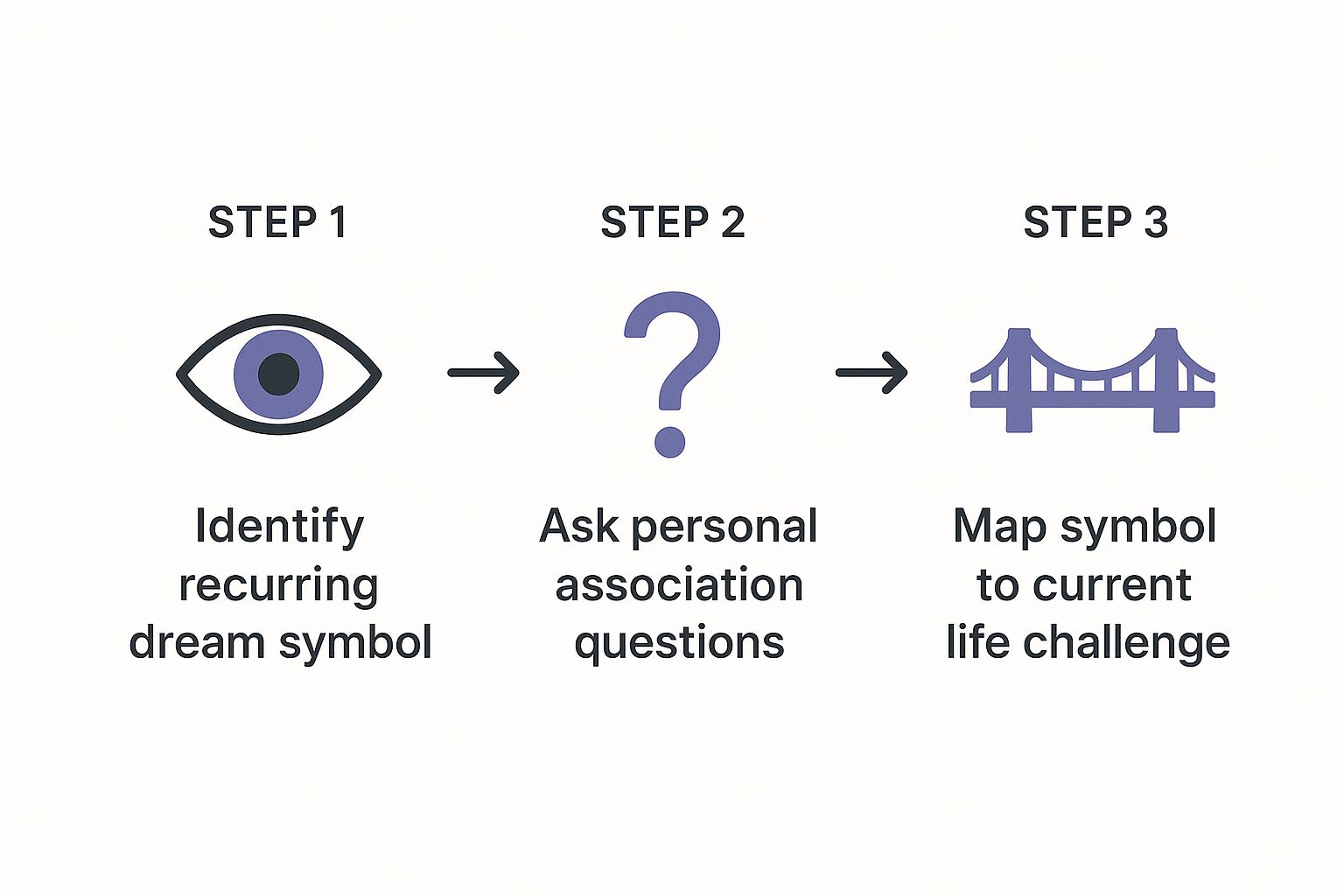
This visual shows you exactly how to go from just noticing a symbol to connecting its deep, personal meaning directly to what’s happening in your life right now.
Asking Transformative Questions
Instead of looking for answers on the outside, you can start a conversation with your own inner self by asking a few powerful questions. The next time a potent symbol shows up in your dream—whether it’s a recurring animal, a mysterious house, or a specific person—just sit with it for a moment and ask:
- What’s my first, gut-level feeling about this symbol? Don’t overthink it. Is it fear, joy, curiosity, or something else? Your immediate emotional reaction is a huge clue.
- Where have I seen or felt this before in my waking life? Does the image remind you of a childhood memory, a recent chat with a friend, or maybe a movie you just watched?
- If this symbol could talk, what one message would it have for me? Let your intuition answer freely, without any judgment.
- How does this symbol connect to a challenge or question I’m facing right now? This is where you build the bridge between your dream world and your real life.
This method of personal association builds an unshakable confidence in your own interpretive skills. You stop relying on other people to tell you what your dreams mean and start trusting the profound wisdom of your own soul.
The Power of Personal Meaning
This whole process is a lot like how we define bigger ideas in our lives, like success or happiness. Take the “California Dream,” for example. It’s a powerful cultural symbol, but its meaning is deeply personal and changes based on who you ask. What once stood for limitless opportunity is now a far more complex idea, reflecting the state’s diverse population and economic realities. Despite being a ‘majority minority’ state with significant growth in Latino and Asian populations, socioeconomic disparities persist, showing that the dream isn’t equally accessible to all. The way this shared cultural dream keeps evolving shows just how much personal context shapes meaning, a truth you can explore by reading more about the changing California Dream.
Just as that collective dream holds a different truth for every person, your personal dream symbols hold a unique meaning that only you can unlock.
Your subconscious doesn’t speak in a universal language; it speaks in the intimate dialect of your own heart. Learning to interpret your dreams is like learning the mother tongue of your soul.
By consistently journaling and applying this kind of personal inquiry, you’ll start to map out your recurring symbols. You might find that for you, a spider always represents creativity and weaving new possibilities, or that a locked door points to a self-imposed limitation.
This is so much more than a fascinating exercise; it’s a sacred practice of self-awareness. It transforms you from a passive dreamer into an active participant in your own spiritual journey, guided by the most authentic voice you will ever know: your own.
Connecting Dreams to Your Waking Reality
Your dreams aren’t just strange little movies playing out in your head at night. They are intimately, profoundly woven into the fabric of your daily experience, acting as a mirror to your waking world. The real magic of dream interpretation happens when you learn to build a bridge between these two realms.
This is where your dreams become a practical, powerful tool for personal growth. The stories, symbols, and feelings that surface in your sleep are direct reflections of your real-life situations—your relationships, your hidden anxieties, and your deepest desires. Understanding how to connect these dots is what makes this practice so incredibly life-changing.
Drawing Parallels and Finding Patterns
The first step is simply to get curious. When a dream leaves a strong impression, take a moment to hold its themes and feelings up against the backdrop of your current life. Ask yourself, “Where else am I feeling this way?”
A recurring dream about being unprepared for an exam, for instance, rarely has anything to do with school. It’s far more likely pointing to a feeling of being tested or judged in your career, a relationship, or a personal project. This is your intuition’s way of flagging an area where you feel exposed or lack confidence. By connecting that dream-anxiety to its real-world source, you can start to address the root cause.
To uncover these connections, ask yourself a few key questions after you’ve written down your dream:
- Who or what in my waking life makes me feel the way this dream did?
- Does the central conflict in the dream mirror a struggle I’m currently facing?
- Is this dream showing me a desire or a fear I’ve been avoiding?
This line of inquiry transforms you from a passive dreamer into an active participant in your own healing journey. It helps you see that your subconscious isn’t just sending you random puzzles; it’s offering you a personalized roadmap.
To help you get started, this table offers a way to think about how common dream themes might connect to your own life. Use it as a jumping-off point for your own reflection.
Bridging Your Dream World and Waking Life
| Common Dream Theme | Potential Waking Life Connection |
|---|---|
| Falling | Feeling out of control, insecure, or unsupported in a specific situation. |
| Being Chased | Avoiding an issue, a person, or an uncomfortable emotion. |
| Flying | A sense of freedom and empowerment, or perhaps a desire to escape current pressures. |
| Teeth Falling Out | Stress, anxiety about your appearance, or concerns about communication. |
| Being Unprepared | Feeling judged, impostor syndrome, or anxiety about a new challenge. |
Remember, these are just common associations. The true meaning is always deeply personal to you and your unique experiences.
The Mirror of Cultural Dreams
This connection between our inner world and outer reality isn’t just personal; it happens on a collective level, too. Think about the “California Dream,” a powerful cultural idea that has long symbolized opportunity and a better life. For generations, it was a beacon of hope, but its meaning is constantly being reshaped by real-world circumstances.
Recent polls show a dramatic shift, with 55% of people no longer believing in the extravagant promises of this dream, largely due to economic realities. This shows how our collective dreams are tied directly to our lived experience. As circumstances change, so does the dream itself. You can explore more about the modern perception of the California Dream and see this in action. Just like this cultural dream, your personal dreams are a direct commentary on your current environment.
Using Dreams as a Guide for Action
Once you start connecting the dots, you can use your dream insights to make conscious choices in your waking life. This is where dreamwork becomes a truly inspiring practice for creating the life you really want.
Your nightly messages can help you:
- Uncover Creative Solutions: A bizarre dream might present a problem from an unusual angle, sparking an innovative solution you hadn’t considered.
- Heed Intuitive Warnings: Dreams often act as a gentle nudge from your intuition, highlighting a situation or relationship that isn’t aligned with your best interests. This is a core part of learning how to develop intuition in all areas of your life.
- Acknowledge Buried Desires: Your dreams can bring to light passions and wants that you’ve pushed aside, encouraging you to honour what truly makes you happy.
Your dreams are not just a reflection of your reality; they are a rehearsal space for your future. They offer a safe place to explore possibilities, confront fears, and awaken the courage to create change when you are awake.
By consistently bridging your dream world and your waking life, you begin a beautiful dialogue with your deepest self. This practice moves beyond simple interpretation and becomes an essential tool for living a more conscious, authentic, and intuitively guided life.
When You Need a Deeper Perspective
Learning to understand your own dreams is one of the most empowering skills you can develop. It’s a direct line to your soul. But let’s be honest—sometimes, you hit a wall.
A dream might be so vivid, so emotionally charged, or so tangled up in symbols that trying to figure it out on your own feels impossible. It’s like standing an inch away from a massive painting; you can see every brushstroke but have no idea what the whole picture is supposed to be.
In those moments, getting an outside perspective isn’t a sign of failure. It’s about knowing when to ask for a helping hand, for someone who can hold the lamp a little higher so you can see the path forward. This is where an intuitive reading can bring incredible clarity.
How an Intuitive Reading Can Help
First, it’s important to know what an intuitive reading is—and what it isn’t. This isn’t about fortune-telling or predicting the future. An intuitive reading is all about your present moment. It focuses on what your dream’s message means for you, right here, right now.
An intuitive reader taps into your energy to help you see what your personal symbols truly mean. A generic dream dictionary could never do that because the reading is about you—your life, your feelings, your unique spiritual journey. That personal connection is everything.
Think of it like this: a dream dictionary is a standard map of a city, but an intuitive reading is like getting a guided tour from a local who knows all the hidden gardens and secret shortcuts.
When Is It Time to Ask for Help?
So, how do you know when it’s time to seek support with a dream? While any dream can be explored more deeply with guidance, a few situations really call for it.
Consider reaching out for a deeper perspective if you’re dealing with:
- Recurring Nightmares: If the same unsettling dream shows up again and again, your subconscious is waving a big red flag. It’s signalling that a core fear or unresolved issue is demanding your attention.
- Dreams with Powerful Emotions: Ever wake up with a feeling so intense it follows you all day? Whether it’s profound grief, pure joy, or overwhelming anxiety, it’s a sign that the dream has struck a major chord within you.
- Mysterious but Important Dreams: These are the dreams you just know are significant, even if you can’t make any logical sense of them. They feel potent and full of meaning, but the message is just beyond your grasp.
It’s fascinating how our personal dreams can also echo the bigger stories of our culture. Take the “California Dream,” for example. It began as a symbol of easy riches during the Gold Rush but has evolved into a much more complex idea of success. Today, fewer than half of Californians born in the 1980s out-earn their parents, which shows how this collective dream has changed over time. Your own dreams can reflect these cultural shifts, too, as you can discover in this overview of the California Dream’s history.
An intuitive reading doesn’t hand you the answers; it helps you hear your own. It simply clears the channel, amplifying your intuition so you can finally understand the message your soul has been trying to send.
Sometimes, the messages we receive in our dreams come from our spiritual support system. Learning what spirit guides are and how they communicate can open up a whole new layer of understanding in your dreamwork.
If you feel stuck, an intuitive reading can be a beautiful next step. Together, we can gently unpack the symbols and feelings, helping you integrate your dream’s wisdom into your waking life so you can move forward with clarity and confidence.
Book an intuitive reading session to unlock the profound guidance your dreams are waiting to offer you.
Your Questions on Dream Interpretation Answered
As you start to tune into your inner world, it’s only natural to have questions pop up. Feeling a bit of uncertainty is a great sign—it means you’re really diving in and engaging with the process. Think of it as a conversation with a part of yourself you’re just getting to know.
To help you on your path, here are a few answers to the most common questions I hear, meant to bring you a little more clarity and confidence.
What If I Can’t Remember My Dreams at All?
Don’t worry, this is probably the single most common hurdle people face, and it’s completely normal. The trick is to gently let your subconscious know that you’re finally ready to listen.
Before you drift off to sleep, set a simple, quiet intention. Something as soft as, “I’m open to remembering my dreams tonight,” can work wonders.
When you first wake up, before you even think about moving or checking your phone, just lie still for a moment. Let any fleeting images, feelings, or even just a single word surface without any pressure. Even if all you grasp is a colour or a vague sense of unease, that’s your starting point. The more you welcome these little fragments with patience, the more your dreams will start to open up to you.
Are Nightmares Just Meaningless Bad Dreams?
Far from it. Nightmares are often the most urgent and important messages we could possibly receive. They are your subconscious mind sounding an alarm, shining a spotlight on deep-seated fears, anxieties, or old wounds that are crying out for your attention.
While they absolutely feel terrifying in the moment, they’re actually incredible opportunities for deep healing. Instead of pushing the fear away, try to get curious about it. Ask yourself, “Where else in my life do I feel this way?” A recurring nightmare, in particular, is a powerful call to action—it’s asking you to finally face something so you can release its grip.
A dream dictionary offers a generic definition, but an intuitive reading deciphers your soul’s personal code. It moves beyond universal meanings to uncover the message your dream holds specifically for you, within the context of your life.
How Is an Intuitive Reading Different?
This is where we go from general to deeply personal. A dream dictionary might tell you a snake represents transformation, but what does it mean for you, right now? An intuitive reading dives into the unique language of your soul.
The symbols in your dreams are woven from the fabric of your own life, your memories, and your spirit. During an intuitive reading, a reader connects with your unique energy to translate what those symbols mean in the context of your current challenges, emotions, and journey. We get to bypass the generic stuff and uncover the intimate message your dream has just for you.
And while talking to a friend is a wonderful way to explore your dream, the most powerful insights always come from within you. A skilled intuitive reader doesn’t tell you what your dream means; they act as a guide, helping you hear your own inner wisdom more clearly, without the filter of someone else’s opinions. It’s a way to access your own truth on a much deeper level.
If you’re wrestling with a particularly vivid dream or just feel you could use a deeper perspective, an intuitive reading can be a beautiful source of clarity. Amy The Psychic is here to help you connect with your inner wisdom.