
If you’re wondering how to overcome self doubt, the first thing to grasp is that you’re not dealing with a simple, fleeting thought. This is a deep-seated pattern. It’s that nagging, quiet voice in the back of your mind whispering that you aren’t smart enough, talented enough, or just plain enough.
The path to reclaiming your confidence isn’t about silencing that voice overnight. It starts with understanding why it has such a powerful grip on you in the first place.
Why Self Doubt Is So Hard to Shake

That voice in your head feels impossible to ignore because it’s a brilliant, convincing storyteller. It spins tales from your past failures, weaves in societal pressures, and adds a relentless commentary from your own inner critic. This narrative can feel like the absolute truth, but it’s just a story—and you have the power to write a new one.
Think back. Remember that time you held back a great idea in a meeting, certain someone else would phrase it better? Or maybe you talked yourself out of that painting class because you were terrified of not being a natural from the get-go. These aren’t just random moments of insecurity. They’re the outward signs of a much deeper internal battle.
The Roots of Persistent Doubt
Self-doubt often sprouts from seeds planted years ago. Our earliest experiences with family, at school, or with friends lay the groundwork for our core beliefs about who we are. A single offhand, critical comment from a boss or one project that didn’t go as planned can echo in our minds for years, creating a faulty blueprint of our own capabilities.
This internal struggle is then amplified by the world around us. We’re constantly bombarded with images of curated perfection, making it incredibly easy to feel like we’re falling short. This culture of comparison is fertile ground for doubt, making you question your own unique journey and value.
This is a particularly tough reality for younger generations. A staggering nearly half (45%) of California adolescents between 12 and 17 have reported dealing with mental health challenges, which can pour fuel on the fire of self-doubt. You can dig deeper into the complex factors affecting California’s youth in this insightful UCLA Health Policy Research brief.
Self-doubt is not a reflection of your true abilities, but rather a distorted lens through which you see yourself. Learning to recognize the distortion is the first step toward seeing clearly again.
Your Inner Critic Is Not Your Intuition
One of the most crucial distinctions you can make on this journey is telling the difference between your harsh inner critic and your gentle, guiding intuition. This is a game-changer.
Your inner critic is loud, demanding, and relentlessly judgemental. It’s obsessed with past mistakes and future fears. Its only goal is to keep you small and “safe” by convincing you not to take any risks.
Your intuition, on the other hand, is your own inner wisdom. It speaks in a much quieter, grounded, and knowing voice, nudging you toward what feels right for your growth and alignment. While spiritual practices like psychic or tarot readings can offer perspectives on external events, an intuitive reading is all about reconnecting you to this powerful inner compass.
When you learn to tune into your intuition, you start building a foundation of confidence that no amount of external validation or criticism can ever shake. The real work is in quieting the critic so you can finally hear the profound wisdom you already carry inside.
Actionable Ways to Tame Your Inner Critic
That voice in your head, the inner critic? It’s a master storyteller, weaving tales of not-good-enough and what-if-I-fail. But here’s the secret: its narrative is just that—a story. And you don’t have to live inside its pages.
The real trick to quieting this voice isn’t to get into a shouting match with it. It’s about calmly, consistently, and deliberately questioning what it’s telling you. This is how you start to rewrite your own internal script, transforming that nagging doubt into fuel for your own growth.
It all starts with simply noticing when the critic shows up. Think of its voice less like an undeniable truth and more like a radio station you’ve accidentally tuned into. You don’t have to believe the broadcast; you just need to acknowledge it’s playing.
This simple act of noticing creates a tiny—but powerful—gap between you and the negative thought. Instead of immediately internalising, “I’m a failure,” you can step back and observe, “Ah, there’s that ‘I’m a failure’ thought again.” That little bit of distance is all you need to start taking back your power.
Practice Cognitive Reframing
Once you can spot your critic’s voice as it appears, you can begin to challenge its authority. A powerful way to do this is through a psychological tool called cognitive reframing. It’s the art of taking a negative thought, holding it up to the light, and replacing it with a more balanced and truthful one.
Let’s say you’ve just given a presentation at work. Before you’ve even sat down, your inner critic chimes in: “You completely fumbled that one section. Everyone probably thinks you’re incompetent.”
Instead of letting that statement become your reality, get curious. Become a gentle detective and start asking questions that poke holes in the story:
- What evidence do I have that contradicts this? “Well, Sarah came up right after and said she found my point on market trends really insightful.”
- Is this thought 100% true, without a doubt? “No. I might have stumbled for a second, but I also nailed the data section and answered every question with confidence.”
- What’s a kinder, more realistic way to view this situation? “I was a bit nervous, and it showed for a moment, but I still delivered my key messages effectively. It’s a great opportunity to practice and get even smoother next time.”
This isn’t about slapping on a coat of forced positivity. It’s about finding the actual, nuanced truth of the situation. It’s a beautiful way to dial down the internal noise, a practice we explore even more deeply in our guide on how to find inner peace.
Start a Confidence Log
Your inner critic has a terrible memory for your successes and a perfect one for your perceived failures. To fight back, you need to create your own evidence. Grab a notebook or start a simple document on your computer and dedicate it to logging your wins. This becomes your personal vault of proof against self-doubt.
Your Confidence Log is your undeniable, written record of your capabilities. When your inner critic whispers you can’t do something, you’ll have a book full of proof that you absolutely can.
At the end of each day, challenge yourself to write down just three things you did well. They don’t have to be earth-shattering accomplishments. In fact, it’s the small things that often matter most.
- Handled a difficult conversation with grace? Write it down.
- Finally tackled that dreaded task you’d been putting off? Log it.
- Made a healthy choice for dinner or got outside for a walk? That’s a win.
Over time, this log transforms into an incredibly potent tool. When you’re having a rough day and that critical voice is loud, you can open it up and get an instant reality check. It reminds you of your resilience, your skills, and all the progress you’ve made, systematically dismantling the critic’s favourite lie—that you are not enough—with cold, hard facts.
Trusting Your Intuition for Unshakeable Confidence
While the mental exercises we’ve covered are fantastic for quieting your inner critic, the most profound, lasting confidence doesn’t come from your head. It comes from your gut.
This is all about learning to trust your intuition—that quiet, steady wisdom that lives beneath the noisy chatter of self-doubt. It’s the subtle feeling guiding you toward one choice over another, the calm certainty that you know what’s best for you, even when you can’t logically piece it all together.
Building this kind of self-trust is a deeply personal journey. When you do, you create a source of strength inside you that no amount of external praise or criticism can touch.
Connecting With Your Inner Guidance
When we feel lost, it’s natural to look for answers outside of ourselves. Many people turn to things like psychic predictions or tarot card readings, hoping to get a glimpse of the future. While those methods can offer a unique perspective, their focus tends to be on external events and what might happen.
An Intuitive Reading works differently. It’s not about predicting what’s going to happen to you, but about shining a light on the wisdom that already exists within you. Think of it as a guided conversation with your own soul, facilitated by an intuitive guide like Amy, designed to validate what you’re already feeling and empower you to follow your own instincts. The whole point is to hand the compass back to you, because your own inner guidance is the most reliable guide you’ll ever have.
True confidence isn’t the absence of fear or doubt. It’s the profound self-trust that you can handle whatever comes your way, guided by your own inner wisdom.
This infographic lays out a simple but powerful way to start intercepting those negative thought patterns. This is a crucial first step, as it creates the mental quiet needed for your intuition to finally be heard.
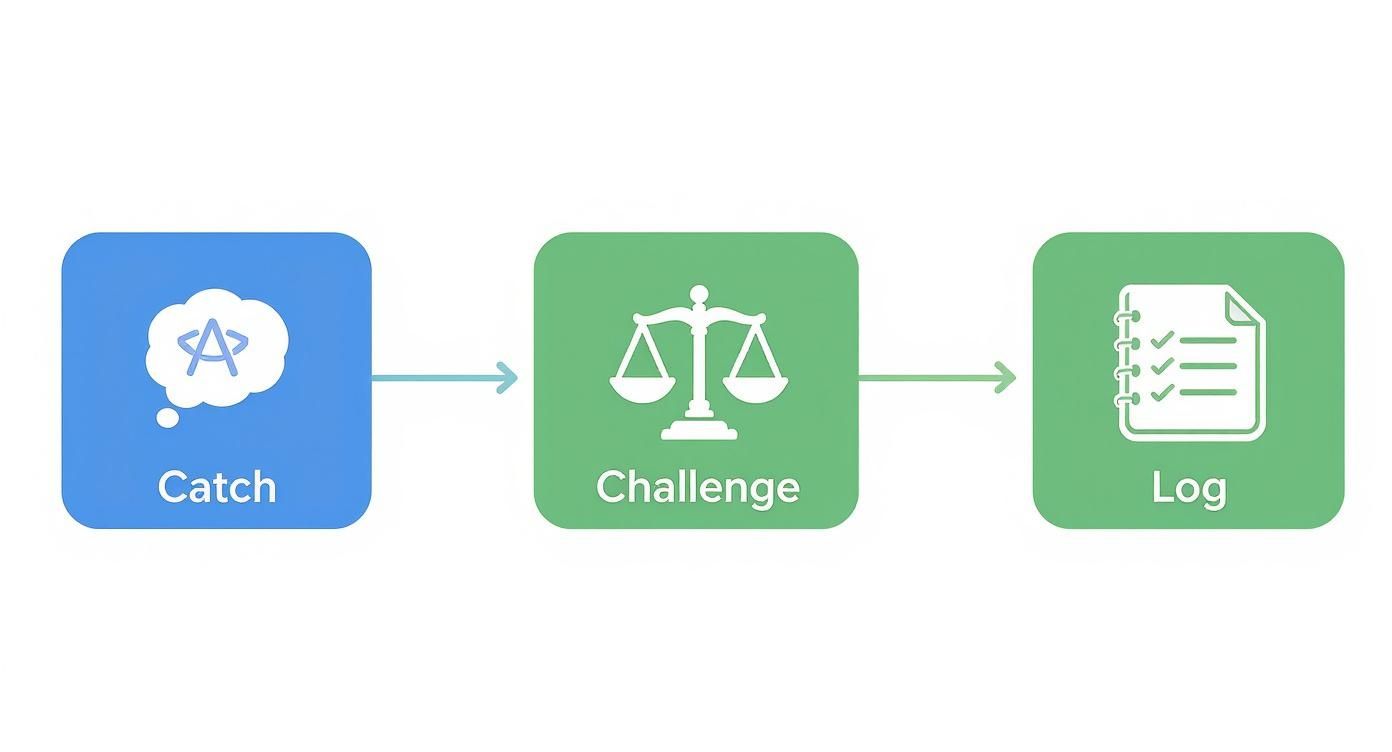
When you consistently catch, challenge, and reframe those critical thoughts, you slowly dismantle their power. You’re clearing the stage for your own intuitive voice to take the lead.
Finding the Right Path to Inner Guidance
With so many options for seeking guidance, it can be hard to know which path is right for you. This table helps clarify the differences, showing how an Intuitive Reading is specifically designed to strengthen your self-trust and help you overcome self-doubt from the inside out.
| Reading Type | Primary Focus | How It Addresses Self Doubt |
|---|---|---|
| Psychic/Fortune Telling | Predicting future events, outcomes, and external circumstances. | Offers potential reassurance about the future, which can temporarily ease anxiety. |
| Tarot Card Reading | Using archetypal imagery to explore current energies and potential paths. | Provides symbolic guidance and new perspectives, but interpretation is key. |
| Intuitive Reading | Connecting you to your own inner wisdom and validating your gut feelings. | Empowers you by proving you already have the answers, building foundational self-trust. |
Ultimately, while many paths can offer insight, an Intuitive Reading is about turning the volume up on your own inner guidance system, which is the most sustainable way to build unshakeable confidence.
Practical Ways to Hear Your Intuition
Strengthening your intuition is a practice, just like building a muscle at the gym. It takes a bit of patience and consistency, but the payoff is a sense of self-reliance that changes everything.
Here are a few simple exercises you can try today to start tuning in:
- Body Awareness Check-ins: Your body is an incredible intuitive instrument. It often picks up on things long before your conscious mind does. A few times a day, just pause and ask, “How do I feel in my body right now?” Notice any tightness, lightness, or other sensations. A “heavy” or constricted feeling can be a sign that something is off, while a sense of openness or relief can signal you’re on the right track.
- Intuitive Journaling: This is a little different from just writing about your day. Grab a notebook, and at the top of the page, write a question like, “What does my intuition want me to know about this situation?” Then, just write. Don’t stop, don’t edit, don’t judge. You might be shocked at the wisdom that flows onto the page when you get your logical mind out of the way.
- Go for a Distraction-Free Nature Walk: Leave your phone and headphones behind. Simply walk and observe the world around you. Notice what your eyes are drawn to, what sounds you hear. This practice helps to quiet the mental chatter, making it so much easier to hear those subtle intuitive nudges.
Cultivating this deep connection is a process, and if you’re looking for more ways to go deeper, our guide on how to develop intuition is a great next step.
As you build this relationship with yourself, you’ll find that overcoming self-doubt becomes less about fighting an internal battle and more about simply coming home to the confident, capable person you’ve always been.
How to Build a Supportive Personal Environment

The people you choose to have in your life are incredibly powerful. They can either be an anchor, weighing you down with negativity, or they can be the wind beneath your wings, lifting you toward your true potential. A huge part of learning how to overcome self doubt is consciously choosing to surround yourself with people who nurture your growth, not those who feed your insecurities.
It all starts with getting really honest about your current relationships. Take a moment and think about how you genuinely feel after spending time with the most important people in your circle. Do you leave them feeling energized and supported? Or do you walk away feeling drained, judged, or somehow smaller than you were before?
Noticing these patterns is the crucial first step. It’s how you begin to build a healthier ecosystem where your confidence can finally blossom.
Identifying Supportive and Draining Connections
Let’s try a little exercise. Mentally sort your relationships into two groups: those who fill your cup and those who drain it. This isn’t about labelling people as “good” or “bad.” It’s simply about recognising how their energy affects your own.
- Energizers are your cheerleaders. They’re the friends who celebrate your successes without a hint of jealousy, the mentors who offer kind and constructive feedback, and the family members who see your light even when you can’t.
- Depleters, on the other hand, are often the unintentional critics. It might be the friend who always pokes holes in your dreams, the relative who constantly questions your life choices, or the colleague whose compliments always feel a little bit off.
Once you have that clarity, you can begin to make intentional shifts. It doesn’t always mean cutting people out of your life entirely. More often, it’s about setting loving but firm boundaries.
For instance, if a family member is always skeptical about your career path, you could gently say, “I know you’re concerned about me, but what I really need right now is your support as I explore this. Can we try to focus on encouragement?”
The Power of a Strong Support System
Your personal environment is more than just your one-on-one relationships; it’s also about the communities you join and the professional help you seek out. A solid social network is absolutely vital for building resilience.
Think about this: a 2015 study found that 89% of people with mental health challenges who had reliable social support felt more motivated to pursue their goals and believed in their own recovery. That connection gives you the confidence to push through when doubt creeps in. You can explore the importance of social support in recovery to see just how profound the impact is.
Your personal ecosystem should be a sanctuary, not a battleground. Curate it with people who see the light in you and reflect it back to you.
Seeking out professional guidance is another incredible way to create a dedicated space for your own growth. Working with a spiritual healer, for example, can provide a focused environment where you can unpack your insecurities and strengthen your inner resolve. When you find a trusted guide, you have a partner who can offer unbiased insight and give you the tools you need to build a more supportive world, both inside and out.
Embrace Imperfect Action to Build Momentum

Here’s a secret I’ve learned over years of helping people find their way: true, unshakeable confidence isn’t about waiting until you feel 100% ready. It’s about finding the courage to move forward anyway, even when your knees are knocking.
Self-doubt loves to live in that quiet, paralyzing space between thinking about something and actually doing it. It spins a nasty web of fear and inaction that can feel impossible to break. But the antidote is beautifully simple: imperfect action.
This is your permission slip to take small, real steps—even when you’re scared, uncertain, or have that nagging voice telling you it won’t work. It’s about choosing progress over perfection and silencing that inner critic with the undeniable proof that you are, in fact, moving.
Break It Down Into “Just For Today” Steps
Staring up at a massive goal is a recipe for overwhelm. It’s like trying to see the top of a mountain from the car park. Instead, just focus on the very first part of the trail.
Let’s say your big dream is to launch a new business. Forget about the five-year projections and complex business plans for a moment.
What’s one imperfect action you can take today?
- Spend 15 minutes researching just one potential competitor.
- Jot down five possible names for your business in a notebook. No editing allowed.
- Draft one quick email to a mentor asking for a moment of their time.
Each tiny step sends a ripple of momentum through your entire being. It’s a powerful message to your doubtful mind that you can do this, which makes tomorrow’s step feel just a little bit easier.
See “Mistakes” as Valuable Intel
When you start taking imperfect action, I guarantee some things will go sideways. That’s just part of the journey. You’ll hit bumps, make mistakes, and maybe even face a little rejection. Your inner critic will pounce on these moments, gleefully shouting, “See? I told you so!”
This is your moment to rewrite the script. A setback isn’t a final verdict on your worth or your abilities; it’s just data. It’s valuable intel showing you what doesn’t work so you can adjust your sails.
Think of it this way: every misstep is a lesson in disguise. Instead of seeing it as proof of failure, reframe it as tuition paid for the wisdom you just gained.
This paralysis of doubt is a silent struggle for so many, especially younger people. A recent poll revealed that while a staggering 94% of Gen Z youth face regular mental health challenges, many feel too embarrassed to ask for help. This stigma feeds self-doubt, creating a huge barrier to growth. You can learn more about these challenges and the stigma surrounding them to see the bigger picture.
Taking that first, wobbly step is often the hardest part. If you’re feeling stuck and unsure which way to turn, an intuitive reading session with Amy can offer the gentle nudge and clarity you need to finally move forward with purpose.
Your Burning Questions on Self-Doubt, Answered
As you walk this path toward greater confidence, a few questions tend to pop up again and again. Think of this as your personal FAQ for those moments when doubt creeps in, helping you find your footing and understand this inner critic a little better.
Isn’t Self-Doubt Just a Form of Humility?
This is such an important question, and it’s one I hear a lot. It’s easy to confuse the two, but they come from entirely different places.
Healthy humility is about having a realistic perspective. It’s knowing your strengths without needing to shout about them, and seeing your weaknesses as simple, honest-to-goodness opportunities to grow. Humility is grounded.
Self-doubt, on the other hand, is a funhouse mirror. It blows your perceived flaws completely out of proportion while making your incredible accomplishments seem tiny and insignificant.
Humility says, “I still have room to learn.” Self-doubt whispers that toxic lie: “You’re not smart enough to even try.”
Will I Ever Reach a Point Where I’m Confident All the Time?
There’s this myth that confidence is some kind of finish line you cross, and once you’re there, you’re set for life. I wish it were that simple! The truth is, confidence isn’t a destination; it’s a practice—a muscle you build over time.
Even the most self-assured people I’ve ever met still face moments of doubt. The key difference? They don’t let it paralyze them.
A truly confident person has learned how to sit with that uncomfortable feeling, acknowledge it, and then take action anyway. It’s not about banishing doubt forever; it’s about learning to trust yourself more than you trust your fear.
I Feel So Stuck. How Can an Intuitive Reading Actually Help?
When you’re drowning in self-doubt, your mind is a chaotic place. It’s loud, it’s confusing, and every voice in there seems to be your harshest critic. Trying to hear your own inner wisdom in that environment is next to impossible. While tools like tarot can offer amazing guidance, they don’t always get to the heart of the matter: your disconnection from yourself.
An intuitive reading works differently. Its entire purpose is to cut through that static and amplify the quiet, steady voice of your own intuition. It’s like holding up a mirror to your soul, showing you the profound wisdom you’ve been ignoring or dismissing.
An intuitive reading doesn’t hand you answers you don’t already possess. It simply helps you hear, trust, and finally act on the guidance that’s been inside you all along.
By creating this clear, supportive space, we can uncover the old, dusty beliefs that are feeding your self-doubt. The goal is to remind you that you are, and always have been, your own best guide. It provides that spark of clarity you need to take the first brave, beautifully imperfect step forward.
If you’re ready to turn down the volume on your inner critic and reconnect with the power of your own intuition, Amy The Psychic is here to guide you. An intuitive reading can offer the validation and clarity you need to finally move forward with confidence. You can book your session with Amy and start your journey today.