
To truly learn how to lucid dream, you first have to get good at remembering your dreams. This starts with keeping a dream journal and making a habit of questioning your reality throughout the day with mindfulness and reality checks. These simple practices are the bedrock of lucidity, building the awareness you need to finally realise, "Hey, I'm dreaming!" From there, your dream world transforms into a powerful space for self-discovery and intuitive guidance.
Your Journey Into Conscious Dreaming Begins Now

Imagine being able to step into your dreams, fully aware and present. Picture yourself exploring, creating, and finding answers to the questions that weigh on your heart. This is the incredible gift of lucid dreaming. It's a chance to turn your inner world into a sacred space for deep insight and growth, where you can consciously navigate challenges in your career, relationships, or life's purpose.
Think of it as opening a direct line to your own subconscious mind. It’s a realm overflowing with clarity and guidance, much like the insights that can come through in an intuitive reading. While we often look outside ourselves for answers, lucid dreaming empowers you to tap into your own deep, inner well of wisdom.
Building Your Foundation for Awareness
Before you can start soaring through your dreamscapes, you need to build a solid foundation. The journey to lucidity doesn't begin with complicated techniques, but with simple, consistent habits that sharpen your awareness in both your waking and sleeping hours. This first phase is all about learning to listen—really listen—to yourself.
Let’s start with two core practices that will dramatically boost your chances of becoming conscious inside a dream:
- Mindful Observation: Throughout your day, just pause. Take a moment to really look at your surroundings and ask yourself, "Am I dreaming?" It sounds simple, but this habit keeps your critical mind switched on.
- Consistent Dream Journaling: This one is non-negotiable for anyone serious about lucid dreaming. Your journal becomes the bridge between your conscious and subconscious worlds, strengthening your ability to remember your dreams in vivid, living colour.
Solid dream recall is the first, most essential step. Without it, even if you do become lucid, the experience will just evaporate by morning like any other forgotten dream. By focusing on these foundational skills first, you make the whole journey feel more natural and deeply personal.
Lucid dreaming isn’t about controlling your dreams; it’s about collaborating with your subconscious. It's a dialogue with your deepest self, offering a unique path to clarity that beautifully complements other intuitive practices.
Connecting Dreams to Intuition
This path of conscious dreaming is deeply connected to your intuitive abilities. The symbols, people, and strange situations in your dreams? They're all messages from your subconscious. Learning to recognise and interact with them while lucid is a powerful way to understand your own inner guidance system. If you want to dive deeper into this connection, exploring how to develop your intuition will be a huge support for your lucid dreaming practice.
This guide will walk you through the first steps of this incredible journey, starting with the basics and building toward the techniques that can unlock full lucidity. Get ready to explore the limitless potential of your own mind.
Prepare Your Mind And Space For Lucid Dreams
Your journey into the incredible world of conscious dreaming doesn't start when your head hits the pillow. It begins right now, in your waking moments. To truly open the door to lucidity, you first have to prepare the runway, creating the perfect conditions for your mind and body to welcome these extraordinary experiences.
Think of it as a beautiful practice in mindfulness. It’s all about tuning into the subtle whispers of your own consciousness and building a bridge between your waking self and the vast, magical landscape of your subconscious. This groundwork rests on two simple but powerful pillars: cultivating dream awareness throughout your day and turning your bedroom into a true sleep sanctuary.
Cultivate Dream Awareness Through Journaling
If there's one habit that will change everything, it's keeping a dream journal. This is so much more than just jotting down a few notes in the morning; it's a sacred act of honouring your inner world.
When you consistently record your dreams the moment you wake up, you send a powerful message to your subconscious: your dreams matter. In return, your mind will start serving you more vivid, detailed, and memorable dreamscapes. What feels like a weak muscle at first—your dream recall—will grow stronger and more reliable with each entry.
But don't just stop at describing what happened. Go deeper. Start looking for your personal dream signs. These are the recurring themes, symbols, people, or feelings that your subconscious uses as its unique language.
Maybe you often find yourself back in your childhood home, or perhaps you frequently dream about losing your keys. These aren't just random bits of imagination; they are breadcrumbs leading you back to yourself. Once you learn to recognise these signs, you're halfway to triggering lucidity from within the dream. You'll see that familiar sign and a spark of awareness will ignite, whispering, "Wait a minute… I know this feeling. I must be dreaming."
Create Your Sleep Sanctuary
Your bedroom should be more than just a place to sleep—it should be a sanctuary. This is your personal haven for rest, peace, and deep introspection. The quality of your sleep has a direct line to the quality and frequency of your dreams, especially the vibrant REM cycles where lucidity is born.
A few small, intentional changes can make a world of difference:
- Embrace True Darkness: Use blackout curtains or a soft, comfortable eye mask to block out every last bit of light. Even the tiny glow from a charging phone can subtly disrupt your sleep patterns.
- Welcome the Quiet: If you live in a bustling area, earplugs or a white noise machine can create a peaceful, consistent soundscape that lulls your mind into deeper rest.
- Set the Mood: An hour before you plan to sleep, dim the lights and put away your phone and laptop. This simple ritual helps your body produce melatonin, the natural hormone that tells your brain it's time to dream.
Creating a peaceful environment is a powerful act of intention. As you prepare your space, you are also preparing your mind for the profound journey ahead. If you're looking to bring this sense of calm into other areas of your life, you might find some wonderful insights in our guide on how to find inner peace.
Your dream journal is a direct conversation with your subconscious. Each entry is a question, and every dream is a potential answer. Pay close attention to the language it speaks.
Master the Art of the Reality Check
The final piece of this preparation puzzle is the reality check. This is the beautiful, mindful practice of frequently questioning your reality all day long. The goal is to build such a strong, automatic habit that you can't help but do it in your dreams, too.
It’s more than just a fleeting thought. The key is to perform a specific action that works differently in the dream world than it does here. And when you do it, genuinely question your reality. Don't just go through the motions—truly wonder, for a split second, if you might be dreaming right now.
Reality checks are your golden tickets to lucidity. To get you started, here are a few simple yet incredibly effective techniques you can weave into your daily routine.
Effective Reality Checks To Start Today
A quick guide to simple reality checks you can integrate into your daily routine to build dream awareness.
| Reality Check Technique | How to Perform It | Why It Works in Dreams |
|---|---|---|
| The Finger-Palm Push | Stare at the palm of your hand and try to push the index finger of your other hand right through it. Genuinely expect it to pass through. | In a dream, the laws of physics are merely suggestions. Your finger will often glide effortlessly through your palm, giving you an undeniable sign that you're dreaming. |
| The Nose Pinch | Firmly pinch your nose shut and try to inhale. | While you can't breathe this way in waking life, you can breathe perfectly fine in a dream because your dream-body doesn't need physical lungs. |
| The Text Check | Look at a piece of text—a digital clock, a book, a sign—then look away for a moment and look back. | Dream text is wonderfully unstable. When you look back, the words or numbers will almost always have changed, scrambled, or morphed into something else entirely. |
Integrating these little moments of questioning into your day is a game-changer. Every time you do one, you're planting a seed of awareness that will one day blossom into a fully lucid dream.
Proven Techniques to Induce Lucid Dreams
Alright, with your mind primed and your sleep sanctuary ready, it's time to dive into the truly exciting part: the techniques that open the door to lucidity. Think of these not as rigid rules, but as different keys on a keychain. Your job is to find the one that fits the unique lock of your subconscious mind.
What works like a charm for one person might not be the right fit for another, and that's perfectly okay. This is a journey of discovery. You're learning the secret language of your own inner world, so be patient and curious with yourself.
This simple flowchart shows how the preparation you've just done leads directly into these powerful methods.
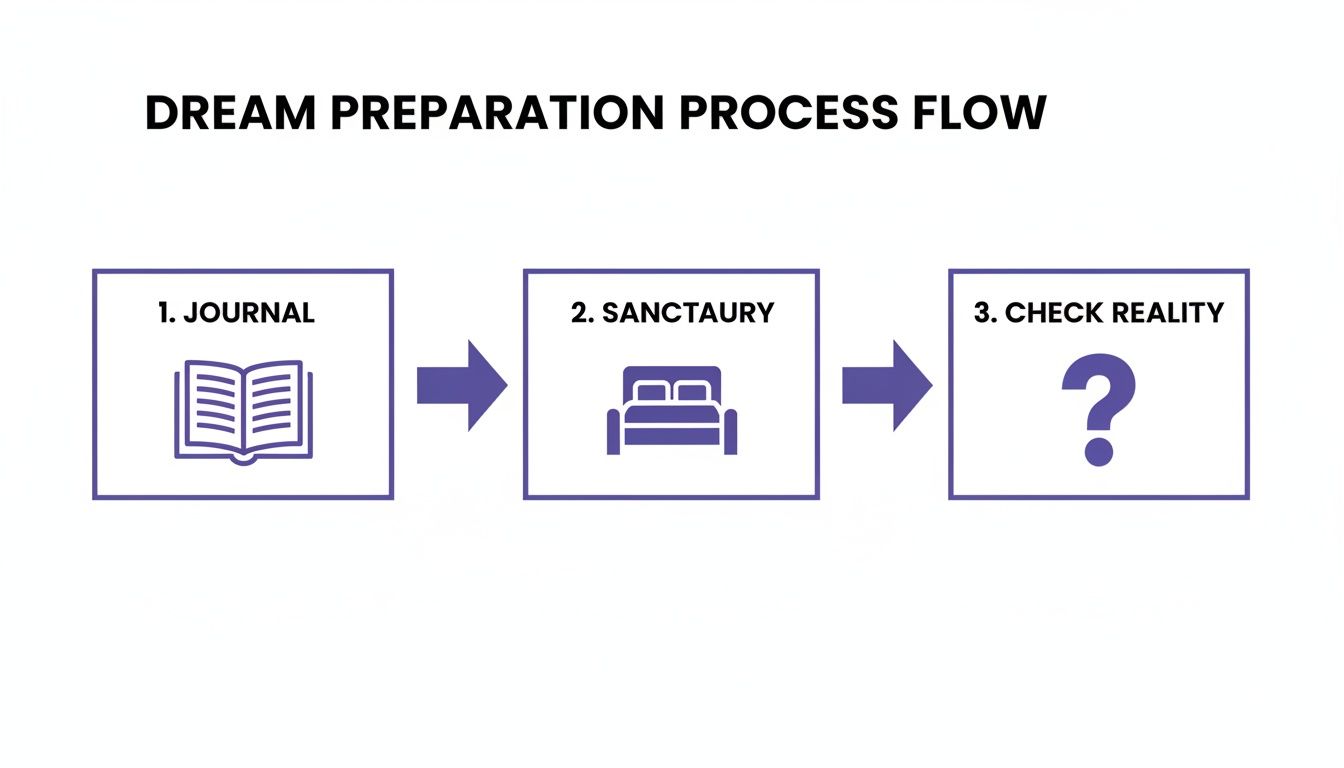
Getting these three pieces down—consistent journaling, a calm space, and frequent reality checks—is what gives the following techniques fertile ground to grow in.
The Power of Intention with MILD
Let's start with a gentle yet profound classic: the Mnemonic Induction of Lucid Dreams (MILD) technique. At its heart, MILD is all about prospective memory—that simple ability to remember to do something in the future. It’s an ideal starting point because it works with your natural sleep patterns, not against them.
The entire practice hinges on setting a clear, heartfelt intention. As you're comfortably drifting off to sleep, you simply repeat a mantra to yourself. Something like, "Next time I'm dreaming, I will realise I'm dreaming." The trick is to really feel it. Visualise yourself in a dream, that spark of recognition hitting, and the world coming into brilliant focus.
This isn't just wishful thinking; you're actively training your mind to spot the signs of a dream. Hold the intention gently, like a feather in your palm, as you let sleep take you. It's like planting a tiny seed of awareness that's meant to sprout right in the middle of your dreamscape.
Strategically Timed Awareness with WBTB
Now, for what many consider one of the heavy hitters: the Wake-Back-to-Bed (WBTB) method. This one is incredibly effective, and when you pair it with other techniques, the results can be mind-blowing. The magic lies in a strategic interruption of your sleep, allowing you to re-enter your most vivid dream phase (REM sleep) with your awareness dialled way up.
Here’s the game plan:
- Set an alarm for about five or six hours after you normally fall asleep. This isn't random—it's timed to catch you in the middle of your longest, most active REM cycles of the night.
- When the alarm sounds, get up and out of bed for 20-30 minutes. You want your mind to be alert, but your body to remain relaxed and ready for more sleep. This is the perfect time to read a few pages about lucid dreaming, look over your dream journal, or just sit quietly and meditate on your goal.
- After that short break, head back to bed. As you drift off this time, your mind is perfectly primed for lucidity. You'll often find you slide right into a dream, fully conscious.
WBTB cleverly uses your body’s own natural sleep architecture to your advantage. By waking and returning to sleep, you carry that conscious alertness with you into the next dream.
For those of you navigating big life questions, whether it's about your career or a relationship, this is huge. Techniques like MILD combined with WBTB have a staggering 54% success rate for inducing lucidity within just one week, according to a breakthrough 2017 study by Aspy et al. It's a fantastic approach for busy Canadians willing to practice those wee-hour awakenings. You can read the full study to get into the nitty-gritty of their findings.
Conscious Entry with WILD
The Wake-Initiated Lucid Dream (WILD) is often seen as the advanced path, but the reward is nothing short of breathtaking. Instead of realising you're dreaming from within a dream, WILD allows you to keep your consciousness intact as your body falls asleep. You literally watch the dream world materialize around you.
This requires a deep state of relaxation and a calm, steady focus. You lie perfectly still, allowing your body to slip into sleep paralysis—a completely natural state that stops you from physically acting out your dreams. While your body goes to sleep, your mind stays awake, a quiet and curious observer.
As you drift in this state, you might experience what's known as hypnagogic imagery: incredible swirls of colour, shifting patterns, or faint sounds. This is the lobby of the dream world. The key is to watch it all unfold with detached curiosity, without getting startled or overly excited.
Successfully navigating this transition is an experience you'll never forget. You witness a dream being born from pure consciousness, fully lucid from the very first second. It takes practice and patience, but WILD offers an unparalleled doorway directly into your vast inner universe.
How To Stabilize And Deepen Your Dream Experience
That breathtaking moment of realisation—“I’m dreaming!”—feels like winning a secret lottery. Yet, that rush can snap you awake before you even get started. True expertise in lucid dreaming is all about learning to settle in and let the adventure unfold.
Anchoring your awareness within the dream is the real game-changer. When you first notice lucidity, turn your attention to the world around you. Engaging your senses right away tells your mind you’re here to stay, making the scene sharper and more stable.
First Steps After Becoming Lucid
In the seconds after lucidity hits, the dream can seem as fragile as a soap bubble. Your next few moves will either keep you in the scene or send you back to your pillow.
Focus on small, sensory gestures that bring calm:
- Rub Your Hands Together: Feel the warmth and texture of your dream skin. This simple action roots you in the moment.
- Spin In Place: A gentle turn steadies the dream’s visuals and refreshes the environment around you.
- Touch And Observe: Kneel down and press your fingers into grass, stone or sand. Study the grain of wood or the veins on a leaf.
These steps let your subconscious know you’re an active participant. Once the world feels solid and vivid, you can move on with confidence, knowing you’ve got the skills to hold lucidity.
Shaping Your Dream World
With stability in hand, the dreamscape becomes your canvas. You have a direct line to your subconscious, so you can invite objects, reshape surroundings or call up scenes that matter to you.
Think of it as a gentle negotiation rather than a pushy demand. Instead of conjuring an object out of thin air, set an intention: look behind you for that special key, or reach into your pocket expecting it to be there.
“Your dream realm reacts to belief rather than coercion. When you trust the process, the experience unfolds effortlessly.”
This isn’t just play—it’s a chance to engage with your inner world. Ask the dream to reveal a symbol for a current challenge or guide you to a place of healing and insight.
Seeking Guidance From Your Inner Self
A stable lucid dream can feel like an intuitive reading you give yourself. You can pose direct questions and receive answers in symbolic form, tapping into deep wisdom you may overlook when awake.
Try summoning a dream guide:
- Turn away, clearly state your wish to meet a wise presence.
- When you turn back, expect someone—anyone—to appear.
- Share your questions:
- “What lesson is hiding in my career journey?”
- “What truth does my heart need about this relationship?”
- “Where is my creativity being blocked right now?”
Interpret the responses through feelings, symbols and metaphors. These insights can shine a light on your waking-life challenges, offering clarity in ways you might never have imagined. Use lucid dreams not just to explore, but to grow.
Using Lucid Dreams For Intuitive Guidance And Healing

Once you get the hang of stabilising your dream state, your practice can blossom into something truly extraordinary. This is where lucid dreaming stops being just a cool skill and starts becoming a powerful spiritual tool for growth, healing, and connecting with your deepest intuition. You’re no longer just exploring; you’re starting a direct conversation with the wisest part of yourself.
This conscious dream space is your personal sanctuary. It's a safe, controlled environment where you can ask for clarity on life’s biggest questions. You can gently face and heal old wounds, smash through stubborn creative blocks, or find peace with complicated relationships—all within the limitless world of your own mind.
Setting Your Intention Before Sleep
The real journey into intuitive dreaming begins before your head even hits the pillow. It all starts with a clear, heartfelt intention. What guidance are you truly seeking? What part of your life needs a little more light?
Before you drift off, take a few quiet moments to really connect with your question. Don’t just think it—feel it. Scribble it down in your dream journal or meditate on it for a few minutes. This simple act tells your subconscious mind what to focus on and prepares it to deliver insights while you sleep.
You could try intentions like:
- "Tonight, I want to see what's blocking my creative energy."
- "Show me the next step in my career that is for my highest good."
- "I’m ready to receive healing energy for a past hurt I’ve been holding onto."
This simple practice turns sleep into a purposeful mission. You're not just a passive audience member in your own dreams anymore; you’re an active participant in your healing and discovery. It's a game-changer for anyone wanting to use lucid dreaming for deeper personal work.
Your Inner Wisdom vs External Tools
There are many beautiful paths to insight. Practices like tarot readings or mediumship are wonderful ways to gain different perspectives, often providing valuable external viewpoints. Think of them as a helpful map for your journey.
Lucid dreaming, though, offers something uniquely personal. It opens a direct line to your own higher self, to that deep well of intuition within you. You aren't just looking at a map; you're talking directly to the mapmaker who lives inside you. An intuitive reading can help you decode these personal messages, but the wisdom itself comes directly from your very core.
While an intuitive reading with a trusted guide can provide incredible clarity and validation, lucid dreaming empowers you to continue that journey of self-discovery independently, night after night. The two practices complement each other beautifully.
Receiving And Interpreting Guidance
Once you become lucid, you can ask your questions directly to the dream itself. You might summon a guide, shout your question to the open sky, or simply hold your intention and see what the dream shows you. The answers rarely come in plain English. Your subconscious speaks its own language: a rich tapestry of symbols, metaphors, and feelings.
For instance, if you ask about a career block, you might suddenly find yourself trying to push a giant boulder up a hill. The feeling of exhaustion and the rough texture of the rock are the answer. Making sense of these messages requires the same skills you’d use to interpret regular dreams, which is why a good foundation in dream analysis is so valuable. Our guide on how to interpret dreams can be a fantastic resource as you build this skill.
Here in Canada, there's a real fascination with these deep states of consciousness. A massive 50-year meta-analysis revealed a 55% lifetime prevalence of lucid dreaming among adults, with most of these experiences happening between ages 16 and 30. What's more, 23% of adults experience lucidity every month or more often, showing a strong, ongoing connection to this inner work. And since strong dream recall is the key, it's amazing that 10.34% of people report it almost every morning—the potential is already there for so many. You can explore more about these lucid dreaming patterns in Canada from the source of these statistics.
Answering Your Lucid Dreaming Questions
Stepping into the world of lucid dreaming is like opening a door to a part of yourself you never knew existed. It’s totally normal to have a few questions as you stand on the threshold. Think of this curiosity as a great sign—it means you’re engaged and ready to explore. Let's walk through some of the most common concerns together, so you can feel confident and supported on your journey.
Is Lucid Dreaming Safe?
This is the big one, isn't it? I get asked this all the time, and I’m happy to say the answer is a wholehearted yes. Most of the fear comes from stories about getting stuck in a dream or experiencing sleep paralysis.
Let's clear that up right now. Lucid dreaming is simply a state of awareness while you're dreaming. You aren't going anywhere; your body is always resting safely in your bed.
That feeling of being "stuck" is actually sleep paralysis, which is a perfectly natural process. Your brain temporarily immobilises your body to keep you from acting out your dreams. It’s a clever safety feature! It can feel a bit strange if you happen to wake up during it, but it’s not harmful. If you ever feel a flicker of anxiety in a dream, just remember who's in charge: you are. Simple things like rubbing your hands together or just focusing on the sensation of your breath can instantly ground you and bring back that feeling of control.
How Long Until I Have My First Lucid Dream?
Ah, the million-dollar question! The truth is, there's no magic timeline. Some people get lucky and have one within the first week. For others, it might take a few weeks or even a month or two of consistent practice. Everyone's journey is unique.
The most important thing you can bring to this practice is patience. Your greatest ally is consistency.
Think of your dream journal and reality checks as more than just a to-do list. They are little conversations you're having with your subconscious, letting it know that you’re serious about waking up in your dreams.
Don’t forget to celebrate the small wins! Did you remember a dream with more detail than ever before? Did a colour seem incredibly vibrant? These are all signs that the connection is strengthening and you're getting closer.
What If I Can't Seem to Remember My Dreams?
If you feel like you're drawing a blank every morning, please don't be discouraged. This is one of the most common stumbling blocks, but it’s absolutely something you can overcome. Think of dream recall as a muscle; the more you work it, the stronger it gets. Even if you think you don't dream, I promise you do—we just need to build a better bridge to those memories.
Here are a few simple things you can start doing tonight:
- Make it easy: Keep your journal and a pen right on your bedside table. No fumbling around in the dark. Make it the very first thing you reach for.
- Plant the seed: As you’re drifting off to sleep, gently tell yourself, "I will remember my dreams." This simple intention primes your mind to hold onto them.
- Wake up slowly: When your alarm goes off, resist the urge to jump up. Stay still for a moment with your eyes closed. Let the feelings and images from your dream drift back to you. They can be incredibly fragile at first.
Even if all you remember is a single colour, a feeling, or a snippet of conversation, write it down! Those tiny fragments are the threads that will eventually weave together the full, beautiful tapestries of your dreams, opening the door to your first lucid adventure.
Your dreams contain a whole universe of wisdom, and becoming a conscious explorer of that universe is one of the most powerful things you can do for your spiritual growth. While lucid dreaming gives you a direct line to your own inner guidance, sometimes an outside perspective can help you see the bigger picture. At Amy The Psychic, Amy offers intuitive readings to help you translate the messages from your subconscious and find clarity on your path.
If you’re ready to dive deeper into your inner world with a trusted guide, you can book an intuitive reading session with Amy today.