
Spiritual development is a journey home to yourself. It’s that quiet, profound process of turning your attention inward to connect with your own deep wisdom, uncover your purpose, and find a sense of peace that doesn’t depend on what’s happening outside of you. Forget rigid rules or dogma; this is about exploring your unique inner landscape and learning to live a life that feels truly, authentically yours.
Your Spiritual Development Journey Starts Here
So often, this path begins with a gentle but persistent inner nudge. A question that bubbles up from somewhere deep inside: “Is this really it? Is there something more?”
This feeling frequently appears during big life shifts—a change in career, the end of a relationship, or even just a slow-creeping sense of being out of sync with your own life. It’s a profound invitation to look past the surface and connect with a deeper part of yourself.
Your journey will look different from anyone else’s, and that’s the beauty of it. For some, it might mean diving into ancient spiritual traditions. For others, it’s about nurturing a personal connection to nature, the universe, or their own higher self. The goal isn’t to have all the answers overnight, but to get comfortable living in the questions and trusting where the path leads you.
Why We Search for a Deeper Connection
Let’s face it, our modern world is noisy. With endless demands and distractions, it’s easy to feel disconnected and off-centre. Spiritual development is your way back. It’s a conscious choice to put your inner peace ahead of external praise or validation. What I’ve seen time and time again is that as you tend to your inner world, your outer world begins to transform in the most incredible ways.
People start this journey for so many reasons:
- A Search for Meaning: They want to understand their purpose beyond the 9-to-5 grind.
- A Need for Peace: They’re looking for real, sustainable tools to manage stress and find calm in the chaos.
- A Desire for Self-Awareness: They’re ready to uncover the old stories and limiting beliefs that have been holding them back.
- A Craving for Intuition: They want to learn to hear—and trust—that inner guidance system for making better, more aligned decisions.
This path isn’t about becoming someone new. It’s about remembering and revealing who you’ve always been. It’s an unveiling of the authentic, powerful self that’s been there all along, just waiting for you to see it.
This longing for connection is a fundamental human experience. In California, a place known for its rich and varied spiritual tapestry, a remarkable 62% of residents say they believe in God or a universal spirit with absolute certainty. This isn’t just a statistic; it points to a powerful undercurrent of spiritual seeking, which often comes to the surface right when we need guidance the most. You can dive deeper into these demographics on Wikipedia.
This simple visual breaks down the core movement of any spiritual journey. It almost always begins with a question, flows into a period of discovery, and finally deepens into a true, integrated connection with yourself and your path.
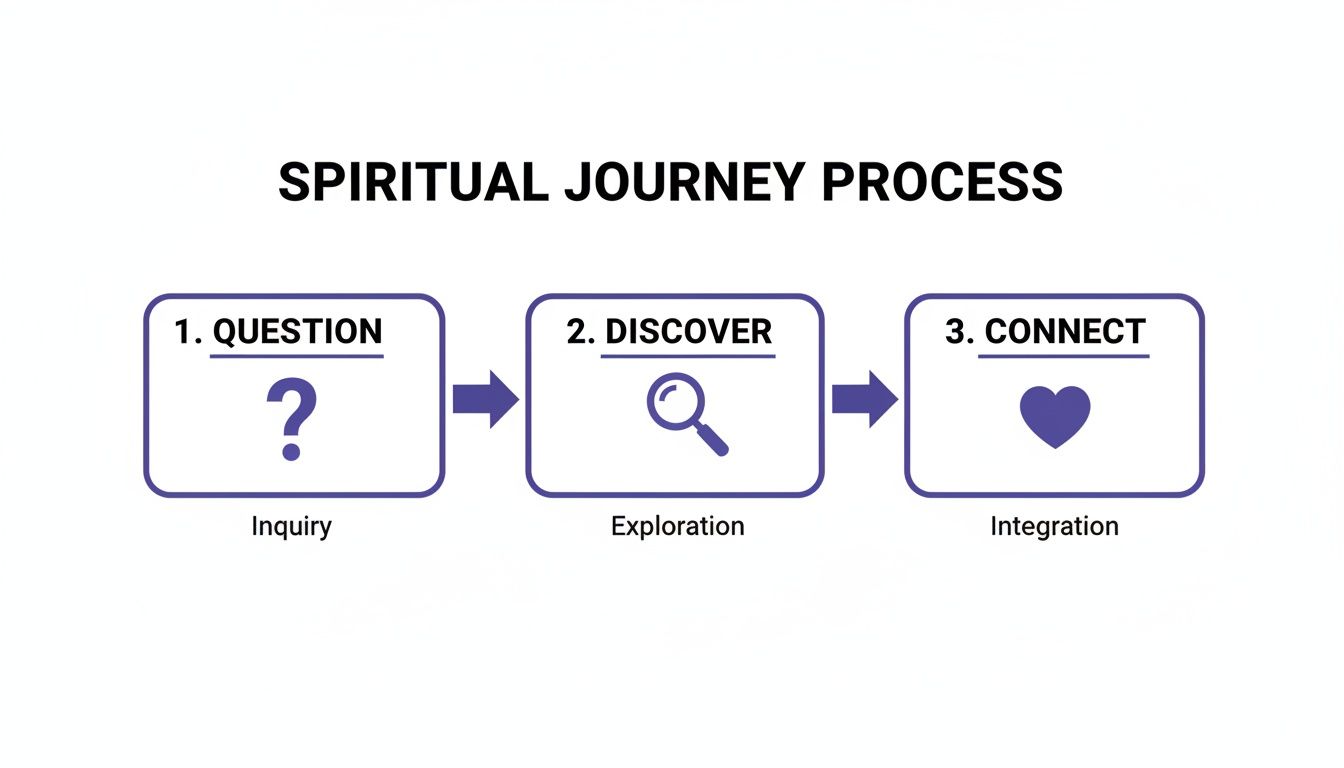
Seeing it laid out like this reminds us that growth is a natural progression. It’s an evolution, not an overnight fix.
To help you get started, here’s a look at the foundational pillars that will support you on this journey. Think of these as your starting points—simple, accessible ways to begin building a stronger connection with yourself.
Core Pillars of Your Spiritual Journey
| Pillar | Focus Area | Simple First Step |
|---|---|---|
| Mindfulness & Presence | Quieting the mind, reducing stress | Sit in silence for just three minutes, focusing only on your breath. |
| Self-Inquiry | Understanding your inner world | Start a journal and write down one thing you’re grateful for each day. |
| Energy & Intuition | Connecting to your inner guidance | Before making a small decision, pause and ask your body: “Does this feel like a ‘yes’ or a ‘no’?” |
These pillars aren’t about adding more to your to-do list. They are about creating small, sacred pockets of time to simply be with yourself.
Tools for the Path Ahead
While this is your personal journey, you don’t have to wander without a compass. Time-tested practices like meditation, journaling, and energy work are powerful ways to explore your inner world.
Sometimes, you also need a trusted guide to help you read the map. While modalities like tarot readings offer incredible structure and symbolism, an intuitive reading offers something different—a direct connection to your unique energy. An intuitive reading isn’t about fortune-telling; it’s about receiving clear, actionable guidance tailored to exactly where you are right now, empowering you to walk your path with greater confidence and clarity.
Your journey toward a more connected, fulfilling life starts with this single, courageous step inward.
Building Daily Rituals for Lasting Growth
Real, lasting spiritual growth doesn’t happen in big, dramatic flashes. It’s built in the quiet moments, woven from the small, consistent rituals you commit to every day. These practices become your anchor, creating a sacred space inside you that shields you from the chaos of the outside world.
The goal isn’t to force yourself into another rigid routine. It’s about discovering what genuinely feeds your soul. Maybe that’s five minutes of silent reflection with your morning tea or a ten-minute brain dump in your journal before sleep. It’s the consistency that matters—even in tiny doses, it creates incredible momentum on your spiritual path.
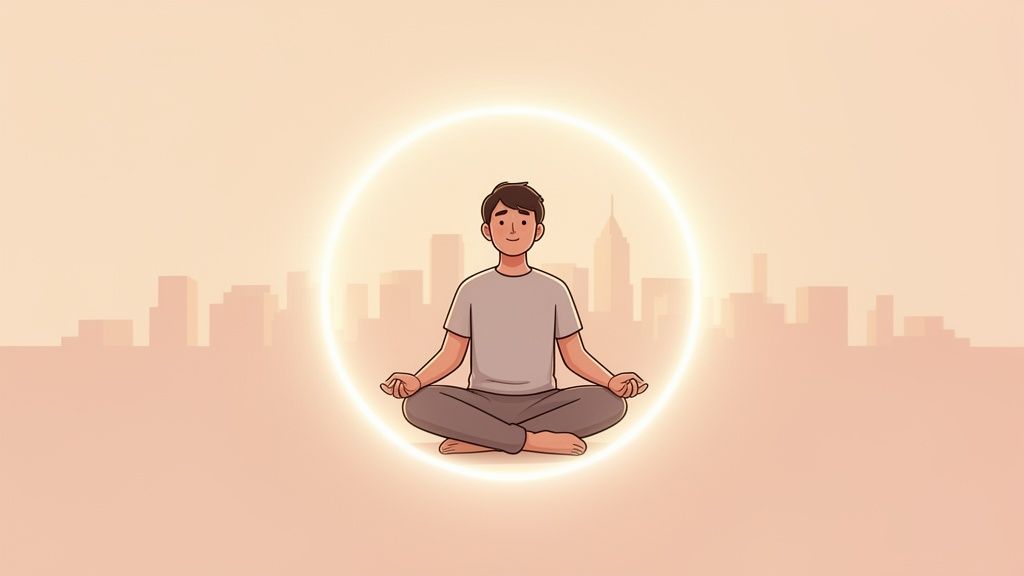
Finding Your Meditation Style
Meditation is often the first thing that comes to mind, but the word itself can feel heavy with expectation. Let’s be clear: the point isn’t to force your mind to go blank. That’s impossible. It’s simply about learning to watch your thoughts come and go without getting swept away by them.
Some days, all you might need is a simple mindfulness practice. Just sit comfortably, close your eyes, and focus entirely on the feeling of your breath. When your mind wanders off (which it absolutely will), you just gently guide it back. It’s a powerful act of being present with yourself.
Other times, you might feel called to something more immersive, like a guided visualization. These are like mini-movies for your soul, using imagery and story to help you connect with your intuition, release heavy energy, or manifest a goal. You can find thousands of free guided sessions online for nearly any intention.
The best meditation practice is the one you’ll actually stick with. Play around with different styles and timings until you find what feels supportive, not like a chore. A consistent five-minute daily practice is infinitely more powerful than a stressful, hour-long session you only do once a month.
The Power of the Written Word: Journaling
Think of journaling as having a direct conversation with your soul. It’s a completely private space to untangle your thoughts, celebrate your wins (no matter how small!), and give a voice to feelings you didn’t even realise were simmering under the surface. It is one of the most powerful tools for self-discovery I’ve ever come across.
Here are a few ways I’ve seen people start a meaningful journaling ritual:
- Gratitude Lists: Before bed, jot down three specific things you were grateful for that day. This simple habit rewires your brain to actively look for the good in your life.
- Stream of Consciousness: Set a timer for 10 minutes and just write. Don’t stop, don’t edit, don’t judge. This “brain dump” clears out the mental clutter and often unearths incredible insights.
- Intuitive Prompting: Before you start writing, pose a question to your higher self. “What do I need to let go of?” or “What is my next right step?” Then, just let the words flow and see what answers come through.
This regular check-in creates a strong bridge between your conscious mind and your deep inner wisdom. It’s a foundational piece for anyone wanting to learn how to find inner peace from the inside out.
Grounding Your Energy Daily
We’re constantly swimming in a sea of different energies—from our coworkers, our families, and even the news. It’s no wonder we can end up feeling scattered or drained. Grounding is the simple act of reconnecting your personal energy to the earth, which helps you feel instantly more centred, calm, and solid in your own body.
You don’t need a formal ceremony for this. A quick and powerful technique I love is the “root visualization.”
- Find a comfortable spot to sit or stand. If you can, get your bare feet on the grass or soil.
- Close your eyes and take a few deep, cleansing breaths.
- Imagine strong roots growing from the soles of your feet, plunging deep down into the very centre of the earth.
- Feel these roots anchoring you securely. Visualize them drawing up a calm, stable, nurturing energy from the earth and into your body.
- As you exhale, imagine any stress, anxiety, or frantic energy flowing down through those roots, where the earth can safely absorb and neutralize it.
This whole process can take less than three minutes, but it can completely reset your entire energetic field. By weaving these small, intentional rituals into the fabric of your days, you build an unshakeable foundation for your spiritual journey.
Learning to Trust Your Inner Compass
We’re all born with intuition. Think of it as a built-in guidance system, a deep, internal knowing that’s always there, ready to point you toward your true north. The real journey isn’t about finding this compass; it’s about dusting it off, learning to quiet the noise of the world, and finally starting to trust where it’s pointing.
This inner voice doesn’t shout; it whispers. It might show up as a gut feeling you just can’t shake, a sudden flash of insight that clears everything up, or even a symbol that keeps appearing in your dreams. Your first task is simply to start noticing these quiet signals. That’s how you begin to build a real relationship with your own wisdom.

Tuning Into Your Intuitive Frequency
At first, telling the difference between your intuition and the loud, demanding voice of fear can feel tricky. Here’s a little secret I’ve learned: intuition usually feels calm, clear, and oddly neutral. Fear, on the other hand, is frantic, repetitive, and always emotionally charged.
One of the best ways to get on your intuition’s wavelength is to intentionally create moments of stillness. No, you don’t need to meditate for hours! It can be as simple as pausing for 60 seconds before making a choice.
Just close your eyes, take three deep, slow breaths, and ask yourself, “What feels most aligned for me right now?” Then, pay attention to what happens in your body. A sense of expansion, lightness, or relief is often a ‘yes.’ A feeling of tightness, dread, or resistance? That’s probably a ‘no.’
Your intuition doesn’t need to shout. It’s a steady, quiet presence that’s always with you. Your only job is to create enough inner silence to hear it. The more you listen, the clearer and more reliable it becomes.
This turn toward inner listening isn’t just a niche practice anymore. A recent national study showed that an incredible 78% of people aged 13-25 now see themselves as at least ‘slightly spiritual.’ Even more telling, 37% are actively using practices to find inner peace. It’s a beautiful shift toward self-discovery and a deeper hunger for authentic guidance.
Decoding Messages from Your Subconscious
Your subconscious has its own language, and it often speaks in symbols and stories—especially when you’re asleep. Dreams are an absolute goldmine of intuitive wisdom, offering you unfiltered glimpses into your deepest desires, fears, and unresolved patterns. Keeping a dream journal is a powerfully simple way to start translating these nightly messages.
Here’s how to get started:
- Set an Intention: As you’re drifting off to sleep, ask your intuition or higher self for clarity on something you’re dealing with.
- Record Immediately: Keep a notebook and pen by your bed. The moment you wake up, scribble down everything you can remember before the logical part of your brain kicks in and edits the story.
- Look for Patterns: Over time, you’ll start to notice recurring themes, symbols, or feelings. Don’t worry so much about what a dream dictionary says. Instead, ask yourself, “What does this symbol mean to me?”
This simple practice builds a bridge to your inner world. It turns “intuition” from an abstract idea into a real, practical tool you can use every single day. For anyone wanting to take this further, our guide on how to develop intuition is packed with more exercises and insights.
Building this trust in your inner compass is the bedrock of your spiritual journey. It gives you the confidence to navigate life’s big (and small) questions, knowing you have the most reliable guide you could ever ask for right inside you.
Finding Clarity with Intuitive Guidance
Your daily practices—meditation, journaling, grounding—are the absolute bedrock of your spiritual journey. They build that quiet, inner sanctuary where you can finally start to hear your own wisdom. But let’s be real, even with the most dedicated practice, there are times when the path ahead gets foggy. You just crave a clearer perspective. This is precisely when seeking a little outside guidance can be a massive catalyst for growth.
An experienced guide is like a spiritual cartographer. They can help you see the entire landscape of your own energy from a new vantage point, pointing out patterns you’re just too close to see yourself. It’s that moment of validation, confirming the quiet whispers of your own intuition and giving you the confidence you need to finally act on them.
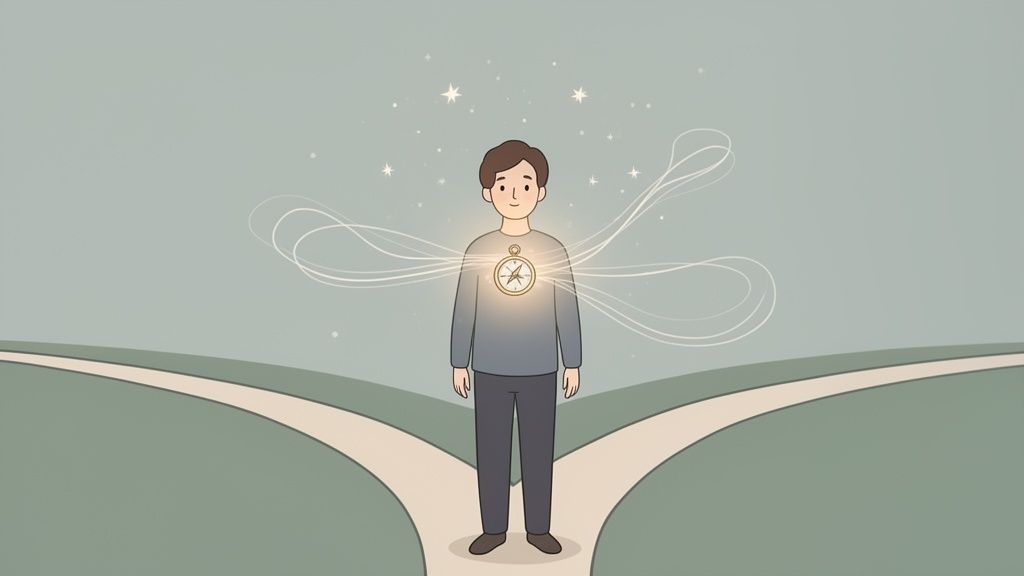
Different Kinds of Spiritual Guidance
When you decide to look for help, you’ll find there are many different avenues, each offering a unique lens. It really helps to understand the distinctions so you can find what truly resonates with where you are right now.
A couple of the most common modalities you’ll come across are:
- Mediumship: This is all about connecting with loved ones who have passed on. A medium acts as a bridge, delivering beautiful messages of love, healing, and closure from the spirit world. While it’s deeply comforting, its main purpose is that communication with the departed.
- Tarot Readings: Tarot uses a deck of symbolic cards to offer insights into your past, present, and potential future. The cards are an incredible tool for self-reflection, helping you explore the archetypal energies playing out in your life and uncover subconscious patterns.
While both of these are powerful in their own right, they serve very specific functions. An intuitive reading, however, brings a different, more holistic approach to the table.
The Unique Power of an Intuitive Reading
An intuitive reading goes beyond specific tools or frameworks to tune directly into your personal energy field. It’s less about one modality and more about a direct, soul-to-soul connection that pulls in information from multiple energetic sources at once.
Think of it this way: Tarot might show you a map of the territory you’re in, but an intuitive reading is like having someone right there in the passenger seat, pointing out the specific landmarks, roadblocks, and hidden shortcuts unique to your personal journey. This type of reading is fundamentally about empowerment.
The purpose of an intuitive reading isn’t to take away your power by telling you your future. It’s to return your power to you by illuminating your present, helping you understand the ‘why’ behind your experiences so you can consciously create the future you desire.
This approach is a game-changer when you’re feeling stuck. Instead of just identifying an obstacle, an intuitive session helps you get to the energetic roots of that block—the limiting beliefs, old wounds, or ingrained patterns that are keeping you from moving forward. Sometimes, this guidance might even come from your own personal support team on the other side. If you’re curious about that, you can learn more about what Spirit Guides are and the important roles they play in our lives.
How an Intuitive Session Sparks Growth
An intuitive reading with a guide like Amy is a team effort. It’s a sacred conversation where your energy and your questions are met with clear, compassionate insight. The focus is always on giving you actionable guidance that you can actually use in your day-to-day life.
People come to sessions with all sorts of questions, often centred around big life areas:
| Category | A Common Question | What an Intuitive Reading Reveals |
|---|---|---|
| Career Path | “Am I on the right track with my job?” | Your energetic alignment with your current role and deep insights into what your soul is truly craving from your work. |
| Relationships | “Why do I keep attracting the same type of partner?” | The underlying energetic patterns and lessons your relationships are trying to teach you. |
| Life Purpose | “What am I really here to do?” | Clarity on your unique gifts and the very next steps to take to live a more purpose-driven life. |
Ultimately, an intuitive reading is a profound investment in yourself and your spiritual development. It offers a moment of pure, focused clarity that can dissolve confusion, validate what you already know deep down, and inspire your next move. It’s a beautiful reminder that you are not alone and that you have an incredible well of wisdom to draw from.
If you’re at a crossroads and feel that personalized, compassionate insight could help light up your path, booking an intuitive reading session with Amy can provide the clarity you’re looking for.
Navigating the Challenges of Your Spiritual Path
Every spiritual journey has its shadows and detours. It’s tempting to focus only on the breakthroughs and moments of pure light, but the real, lasting growth happens when we learn to navigate the inevitable challenges with a compassionate heart. This path isn’t a straight, easy line to enlightenment; it’s a messy, beautiful, human experience, and that includes seasons of doubt, frustration, and even burnout.
These bumps in the road aren’t signs that you’re failing or doing something wrong. Think of them as signals that you’re going deeper, shedding old skin, and making room for a more expansive awareness. Acknowledging these tough moments is a massive part of your spiritual development.
Understanding Spiritual Bypassing
One of the sneakiest hurdles you might come across is something called spiritual bypassing. This is when we use spiritual ideas or practices to sidestep difficult emotions, deep-seated wounds, or fundamental human needs. It’s like slapping a glittery “love and light” sticker over a wound that desperately needs to be cleaned and cared for.
You see it all the time. Someone might dismiss their very real anger by declaring, “I’m choosing a higher vibration,” instead of exploring why they feel so upset. Or they might shut down feelings of grief by insisting, “Everything happens for a reason,” without actually giving themselves the space to mourn their loss.
Spiritual bypassing is a defence mechanism, not a sign of enlightenment. True spiritual maturity means integrating all parts of your human experience—the messy, the painful, the confusing—not pretending they don’t exist.
The way through this is to give yourself permission to feel everything without judgement. Your emotions aren’t your enemies; they’re messengers. Simply acknowledging your sadness or frustration is the first real step toward healing and releasing it.
When You Feel Stuck or Drowned in Doubt
It happens. One month you feel deeply plugged in and inspired, and the next, it’s like the well has run completely dry. This is often what people call the “dark night of the soul,” a period where old beliefs are crumbling to make way for a new, more authentic awareness to take root.
During these times, it’s so easy to feel like you’ve lost your way or that all your hard-earned progress has just vanished. The key here is not to force a breakthrough. Instead, treat this phase with radical gentleness.
A few things to try when you’re in this space:
- Go back to basics. Return to the simple practices that first brought you comfort. Maybe it’s a short, silent meditation, a quiet walk in the woods, or journaling for just five minutes without a goal.
- Shift your focus outward. Instead of striving for a spiritual ‘high,’ pour your energy into simple acts of kindness. Making a meal for a friend or volunteering can reconnect you to a sense of purpose that exists beyond yourself.
- Get curious. Ask gentle questions instead of demanding answers. “What is this feeling of stuckness trying to teach me?” is a world away from “Why can’t I feel connected anymore?”
This feeling of being stuck is often a necessary pause—a spiritual winter before a new spring. It’s a time of integration, where your soul is busy processing everything you’ve learned on a much deeper level.
Dodging Spiritual Burnout
In all our enthusiasm for growth, it’s surprisingly easy to push too hard. Your spiritual development can quickly turn into just another stressful item on your to-do list. Spiritual burnout is what happens when your practices start to drain you instead of fill you up. You might feel exhausted, cynical, or even resentful toward the very rituals that once brought you joy.
The antidote is simple: balance. Listen to your body and spirit. Sometimes, the most spiritual thing you can do is take a nap, watch a silly movie, or just do nothing at all.
This isn’t just “woo-woo” thinking; it’s a recognition of our holistic needs. Even major health systems are catching on. For instance, California’s CalAIM initiative is now integrating spiritual care into health services, acknowledging that our inner state is vital for overall well-being. This is especially true when we’re navigating big life challenges like grief or career uncertainty. You can read more about this powerful connection between spirituality and health in Health Affairs.
Common Spiritual Hurdles and How to Overcome Them
Facing these challenges is a universal part of the journey. To help you identify and move through them, here’s a look at some common obstacles you might encounter.
| Obstacle | What It Feels Like | A Constructive Approach |
|---|---|---|
| Spiritual Bypassing | Feeling pressure to be “positive” all the time; dismissing negative emotions as “low-vibe.” | Allow yourself to feel the full spectrum of emotions. Ask, “What is this anger/sadness trying to tell me?” |
| Doubt & Disconnection | Feeling like your practices aren’t “working” anymore; a sense of spiritual emptiness or loneliness. | Return to simple, grounding practices. Focus on gentle self-care and curiosity rather than forcing a connection. |
| Spiritual Burnout | Exhaustion, resentment toward your practice, feeling like it’s a chore rather than a comfort. | Take a break! Let your practice be fluid. Sometimes rest is the most productive spiritual act you can perform. |
| Comparison & Imposter Syndrome | Feeling like you’re not “spiritual enough” or that others are more advanced on their path. | Unfollow accounts that trigger comparison. Remind yourself that every single journey is unique and unfolds in its own time. |
Remember, these aren’t roadblocks; they’re part of the terrain.
Ultimately, learning to navigate these challenges with grace is what forges true spiritual strength. It teaches you that your connection to yourself and the universe isn’t fragile; it’s resilient enough to withstand doubt, frustration, and the beautiful messiness of being human.
Your Spiritual Questions, Answered
Venturing into your spiritual development is one of the most personal journeys you can take. It’s only natural to have questions pop up along the way! Whether you’re taking your first tentative steps or have been walking this path for years, curiosity is a beautiful sign that your heart is open and ready.
Let’s dive into some of the most common questions that come up. Think of this not as a rulebook, but as a friendly chat to bring a little more clarity and encouragement to your journey.
How Do I Know If I’m Really on a Spiritual Path?
This is probably the number one question people ask, and the answer is refreshingly simple: if you’re asking the question, you’re on the path. Seriously.
A spiritual path isn’t some exclusive club you have to qualify for. It’s not about reaching a certain “level” of enlightenment. It’s a conscious decision to connect with your inner world and see life through a more meaningful lens.
You’re already on your way if you notice things like:
- A heightened sense of self-awareness: You’re starting to see your own habits, emotional triggers, and that non-stop inner chatter with a little more clarity.
- A hunger for meaning: You find yourself searching for a purpose that goes beyond the 9-to-5 grind or just checking things off a to-do list.
- Your intuition is getting louder: Those little gut feelings, inner nudges, or “I just knew it” moments are starting to happen more often.
- Your values are shifting: Things like inner peace, genuine connection, and living authentically suddenly feel far more important than what others think.
Your spiritual path isn’t a destination you eventually arrive at. It’s the way you choose to walk through your life, every single day—with curiosity, self-compassion, and the courage to look within.
What’s the Difference Between Being Religious and Being Spiritual?
It’s easy to get these two tangled up, but they’re quite distinct, though they can certainly overlap.
Religion is often about a structured community framework. It typically involves a shared set of beliefs, specific rituals, and community practices, often centred around a particular text or deity. It offers a clear path and a strong sense of belonging.
Spiritual development, on the other hand, is intensely personal. It’s about cultivating your own private connection to whatever you consider to be a higher power—be it the universe, nature, or your own soul. It’s fluid and doesn’t demand you follow a specific set of rules.
You can be religious and spiritual, just one or the other, or neither. It’s all about what resonates with you.
What If I Don’t Know What to Believe?
Welcome to the club! Not having it all figured out is perfectly normal—in fact, it’s a vital part of the process. Your journey is one of discovery, not a test you can fail. Doubt and uncertainty aren’t weaknesses; they’re invitations to get curious.
Instead of feeling pressured to slap a label on your beliefs, just start with what feels good and true for you, right now.
- Does being in the forest make you feel connected to something bigger?
- Does a few minutes of quiet reflection bring you a sense of calm?
- Did you read a philosophy or quote that just clicked?
Follow those little threads. Your understanding and your beliefs will naturally shift and grow as you do. The exploration is the point.
How Can an Intuitive Reading Actually Help My Spiritual Growth?
While your daily practices are the bedrock of your journey, sometimes an outside perspective can act like a key, unlocking a door you didn’t even see. While a mediumship reading connects with loved ones who’ve passed and tarot uses symbols to reveal patterns, an intuitive reading is a little different.
It’s a process where a guide tunes directly into your unique energy field to offer personalized insight. It’s less about a specific tool and more about a direct, soul-to-soul connection.
This is especially powerful for spiritual development because it can:
- Validate What You Already Know: Hearing an intuitive articulate feelings you’ve had deep down is incredibly affirming. It gives you permission to finally trust your own inner wisdom.
- Pinpoint Energetic Blocks: A reading can shine a light on the subconscious beliefs or old emotional patterns that are keeping you stuck, giving you a clear idea of what’s ready to be healed.
- Give You Actionable Next Steps: This isn’t about predicting a rigid future. It’s about empowering you with practical, compassionate guidance to navigate where you are right now and consciously create what comes next.
Think of an intuitive reading as a clear mirror, reflecting your own soul’s truth back to you so you can confidently take your next aligned step.
At Amy The Psychic, providing that exact clarity is what it’s all about. If you feel called to understand your journey on a deeper level and receive guidance that’s tailored specifically to your energy, an intuitive reading can light the way.
Book your intuitive reading session with Amy and gain the insight you need to move forward on your path with confidence and peace.